Wednesday, November 16, 2022

Review: Reading Like a Writer (by Francine Prose)

My Rating:  4 stars

As I mentioned in an earlier review of a different book, I was inspired to finally start my book writing project a few weeks ago and while it's been slow-going (and most likely will continue to be), I'm glad I decided to start working on it rather than continue to hold off until I have "more time."   Because of this, I've been trying to squeeze some books about writing (most of which I've had on my TBR for ages but just never got the chance to pick up) into my reading schedule, as I wanted to keep the momentum going in terms of inspiration.  One of the books that a writer friend pointed me to as a "must-read" is author Francine Prose's bestselling classic Reading Like a Writer:  A Guide for People Who Love Books and for Those Who Want to Write Them. I had actually never heard of this book prior to my friend recommending it (and I'm also not familiar with Francine Prose as a writer — I had heard of her, but had never read anything by her), but as soon as I saw that title, I just knew I had to pick it up right away – which I'm glad I did because there were so many insightful ideas in here!  


Prose starts her book with a question that has been asked many times over the years and to which there technically isn't a straightforward answer:  "Can creative writing be taught?"  While Prose never attempts to actually answer this question directly (which makes sense because, in my opinion, it's impossible to answer simply "yes" or "no" to this particular question), she does use her own experience on how she "learned to write" to explain her thoughts on it.  I'm not going to even attempt to summarize the entirety of her experience / thoughts (it's not possible to anyway), but I wanted to share a few quotes that essentially form the premise of what her book is about.


  • "Like most – maybe all – writers, I learned to write by writing and, by example, by reading books."
  • "In the ongoing process of becoming a writer, I read and re-read the authors I most loved.  I read for pleasure, first, but also more analytically, conscious of style, of diction, of how sentences were formed and information was being conveyed, how the writer was structuring a plot, creating characters, employing detail and dialogue.  And as I wrote, I discovered that writing, like reading, was done one word at a time, one punctuation mark at a time."
  • "I read closely, word by word, sentence by sentence, pondering each deceptively minor decision the writer had made."
  • "What writers know is that, ultimately, we learn to write by practice, hard work, by repeated trial and error, success and failure, and from the books we admire."
  • "And so the book that follows represents an effort to recall my own education as a novelist and to help the passionate reader and would-be writer understand how a writer reads."


In the version of the book that I bought, there is a reprinted interview in the back that Francine Prose did with The Atlantic in July 2006 (around the time the book first came out) where she adds additional insight about why she wrote this book, which  I feel are worth sharing as well (if you do decide to pick up this book, I strongly recommend getting the version that has the interview).


  • "If I had to really characterize the book, I'd say it's about the pleasure of reading and about learning to write."
  • "For me, writing this book was a pretty passionate endeavor.  What I'm hoping is that some of that passion gets through.  Because it seems to me that the most important thing in any discussion of reading and writing is that intense commitment to the whole process."


The following is one of my favorite quotes from that interview.  In response to the interviewer's question referring back to another interview that Prose did back in 1998 where she said that she became a writer because she was an avid reader, so she would often get perplexed by the fact that some of her students who wanted to be writers either weren't actually reading or weren't reading passionately:  "That hasn't gotten any better, let me tell you.  In fact, I can look back and identify a few incidents that led up to my writing the book….I don't quite get it.  On a very basic level, I can't figure out why people would want to write unless they like to read.  I mean, what would be the point?  For the incredibly glamorous fast track lifestyle?  I don't think so." (The wit in those last 2 sentences made me chuckle!)


One of the things I like about this book is that, despite the title, it doesn't actually read like a "how-to" guide on writing.  Prose doesn't tell the reader how to write or what words to use / not to use, etc.  Rather, she takes some of the basic elements of story writing (i.e. sentence structure, character, details, etc.) and, using excerpts from works by other authors (both classic and contemporary, but mostly classic), illustrates how they utilized those elements in their writing. Personally, I found this method useful, though of course, depending on what you're looking for in books of this nature, this could be a huge turn-off for those who prefer a more traditional "how-to" approach — which is why I feel it's necessary to mention so that if you plan to pick this up, you know what you're getting into.


After showing us many examples of writing that did a good job of demonstrating the particular element the chapter focused on, Prose caps it all at the end with the assertion that there is actually not one "correct" way to write, which I found interesting.  She writes:   "And actually, many things that we ourselves consider indispensable for a work of fiction may turn out, the more we read, to be superfluous.  If the culture sets up a series of rules that the writer is instructed to observe, reading will show you how these rules have been ignored in the past, and the happy outcome.  So let me repeat, once more:  literature not only breaks the rules, but makes us realize that there are none."


By now, it's probably quite obvious that I got a lot out of this book.  Having said that, of course the book wasn't perfect and there was definitely room for improvement in some areas in terms making the book more readable and accessible overall — i.e.: some of the excerpts used were a bit too long, and in some cases, a little repetitive in illustrating a particular element; also would've preferred a better balance between excerpts from classic works and ones from more contemporary works — but definitely not a dealbreaker in my opinion. 


Not only did this book provide me with some great reading and writing advice, it was also funny and engaging, which I totally was not expecting.  I actually wish that I had read this book way back when it first came out, as it probably would've motivated me to start my book project earlier.  I especially appreciate the fact that Prose's overall message with this book is so simple (how to read like a writer), yet still tremendously helpful.  Case in point – I don't remember which section I was reading exactly, but as I put the book down for a quick break after finishing one of the chapters, I was hit by a sudden bout of inspiration and instead of picking up the book to continue reading right at that moment (which was my original intention), I ended up spending that time working out a scene that I had struggled with writing earlier.  


After reading this book, in addition to inspiring me to want to apply some of these concepts to my own reading and writing life, I'm also eager to check out some of Francine Prose's other works as well!


Friday, November 11, 2022

Review: Signal Fires (by Dani Shapiro)

My Review:  5 stars

It's not often that I find myself at a complete loss for words after finishing a book, to the point that I have to sit with it for a few days in order to form any semblance of coherent thoughts to actually put down on the page. That's how awed I was by Dani Shapiro's latest book, Signal Fires (her return to fiction after 15 years).  Though I had not read any of Shapiro's fiction or non-fiction works prior to this (something that I intend to rectify of course), I decided to pick this one up because of strong recommendations by a few book friends who said I would probably love this because the writing style is reminiscent of one of my favorite authors, Fredrik Backman.  And they were right, of course, as I did end up loving this one!

This book is one where it's best to go in knowing little to nothing about the plot in order to get the full emotional experience of it (though with that said, I do think that the publisher did a darn good job with the summary, which came across to me as carefully crafted with particular word choice in mind so as not to give away certain important plot points).  This is a character-driven story through and through (which I love!), but uniquely told in a nonlinear format that jumps back and forth between multiple perspectives as well as timeframes.  Usually, books of this nature (told from multiple characters' perspectives plus jumping back and forth in time) don't work too well for me, as it's distracting and often interrupts my reading flow — but for some reason (and surprisingly), it didn't bother me in the slightest with this book.  In fact, I barely noticed the unusual structure as I was reading, only figuring it out when I finished the book and was getting ready to write this review — undoubtedly a testament to Shapiro's mesmerizing and exquisite storytelling.  Indeed, I could not put this book down once I started it, nearly foregoing sleep just to finish it.

As mentioned earlier, I love character-driven stories, which was definitely an advantage going into this one, but even without that predisposition, I probably would've fallen in love with all the characters in here anyway based on the way they were written.  My favorite character was definitely Waldo, but Ben and Theo also stole a piece of my heart with their story arcs.  Even Shenkman and Sarah, two hugely flawed characters who tried so hard to do the right thing in the hopes of turning their lives around, got to me emotionally with their struggles, to the point that I was rooting for them as well.

Emotionally, there was actually a lot to unpack with this story and if I'm being honest, I would say I'm not quite ready to move on from this one yet (though I know I need to given the pile of books I have yet to get to).  I admire and appreciate the way that Shapiro was able to take life's most ordinary moments (moments we often take for granted) and build them into a story so rich with emotional nuance and poignancy. This was a quiet but powerful story, with an undercurrent of sadness throughout that broke my heart, yet at the same time, there was also an overarching message of hope and love that balanced things out so beautifully.  

Needless to say, I recommend this book wholeheartedly, though be prepared for the emotional journey that it will take you on.  For me personally, I intend to delve further into Shapiro's backlist books when I get a chance — can't wait!

Sunday, November 6, 2022

Review: Now is Not the Time to Panic (by Kevin Wilson)

My Rating: 4 stars

"The edge is a shantytown filled with gold seekers.  We are fugitives, and the law is skinny with hunger for us."

The plot of Kevin Wilson's latest novel, Now Is Not the Time to Panic, revolves around this phrase in a huge way.  Of course, how and why this phrase is important is not going to make sense to anyone who hasn't read the novel and I actually don't plan on revealing too much of the plot in this review, as the unique nature of this book is that you need to read it for yourself in order to see where the story takes you.  All you need to know is that majority of the story takes place in Coalfield, Tennessee in 1996 and the two main characters are sixteen-year-old misfits Frances "Frankie" Budge and Ben "Zeke" Brown.  Frankie and Zeke, two lonely teens from broken families, meet for the first time during the summer of 1996 and, largely left to their own devices, work on a "project" together that ends up changing their lives.

With two teenage protagonists at its core, this is no doubt a coming-of-age story, but it's one unlike anything I've ever read.  I will admit that, at first, I worried about whether the story would have too much of a YA feel to it, and while there is definitely some "teenage angst" with the characters, the way it is written feels very clearly "adult" to me.  Kevin Wilson has a unique way with words and with that, is able to tell a compelling, original, and emotionally nuanced story quite effortlessly.  Indeed, there were so many different emotions that went though my mind as I read this one — it was heartwarming, yet also heartbreaking; funny at times, but also sad and serious when it needed to be; weird to the point that, at times, I honestly wasn't too sure what I was reading, but yet some parts were so familiar and relatable, I found myself nodding in recognition;  there were moments of sweetness (though not the overly saccharine kind), but also moments that were anger-inducing where I couldn't help but shake my head at how things got that way.  

One of the things I loved most about this story was how realistically-rendered the characters were.  Wilson didn't shy away from writing about the "messiness" of his characters' lives — which, in doing so, reflected the realities of ordinary life in a universally resonant way that made it easy to connect with the characters despite a reader such as myself having completely different backgrounds and experiences than them. 

I definitely recommend this book, but want to also put in a word for the Author's Note, which I feel is just as much of a "must-read" as the book itself.  It was of course interesting to read about the inspiration for this story, but more importantly, the insights it provided enhanced my understanding of the story, which I always appreciate.  After finishing this book, I immediately put Wilson's other works on my TBR — hopefully I'll be able to get to those soon!

Received ARC from Ecco via NetGalley. 


Sunday, October 30, 2022

Review: Our Missing Hearts (by Celeste Ng)

My Rating:  4.5 stars

In her Author's note at the end of this book, Celeste Ng writes, "Bird and Margaret's world isn't exactly our world, but it isn't not ours, either."  This quote encapsulates my first reaction as soon as I turned the very last page of the story:  this book scared the hell out of me.  No, this was by no means a horror novel in the sense that there were no evil monsters lurking in the shadows or gory murders taking place every couple pages or anything like that. What made this story so scary was how recognizable the dystopian world that Ng created was, especially when looking at the past history of our country, the current realities of what our society has become, and where we are headed in the future.  Even scarier still  for me was reading this book as a  Chinese woman with a background that shares some similarities with Margaret's, and also having myself experienced first-hand many of the prejudices and micro-aggressions that she did at various stages of her life, it heightens the notion that this dystopian society will indeed (unfortunately) become our grim reality in the years to come.  

As I was gathering my thoughts to write this review, I decided to deliberately keep it short and vague, mostly because I feel the power of this story is in the experience of reading it. This book was definitely a departure from Ng's previous works and to be honest, I did hesitate to pick it up at first knowing that it would be science fiction (a genre that isn't usually my cup of tea).  But as soon as I read the first page, I was drawn in by Ng's beautiful and absorbing writing as well as her masterful storytelling.  Now after having read this book, I feel that it would be more appropriate to put this in the "genre mashup" category rather than solely science fiction, as there were aspects of historical, literary, and contemporary fiction in here —  I think this is important to point out in case there are other readers like me who might be put off reading genres that they don't usually prefer.  I actually ended up finishing this book in essentially one sitting, as I got so absorbed in the story that was unfolding, I had to keep going in order to see how things would turn out.

Lastly, a word about the rating, which I agonized over for quite some time.  While there was so much about this book that deserved 5 stars, I ended up going the 4.5 stars route because I felt that the story overall didn't quite have the level of emotional resonance as Ng's previous books, especially as it relates to the characters  — which I guess wasn't too surprising given that some of the focus had to be shifted to the "world-building" aspects of the dystopian society that was both a reflection and not a reflection of our current society.  As I mentioned earlier in my review, I definitely felt fear and anger at everything that was happening throughout the story, but I didn't really feel the personal, emotional connection to the characters that I was expecting.  Having said that, I still found this to be brilliantly written and a worthy (I would even say necessary read) — though of course, given the subject matter, it won't be an easy read by any means.  

Sunday, October 23, 2022

Review: The Checklist Manifesto (by Atul Gawande)

My Rating:  4 stars

Looking through my reading log the past couple weeks, I realize that I've been a bit behind with my reading the past couple weeks. This was due mainly to a few projects that I had to be involved with at work, which ended up requiring a bigger time commitment than I originally anticipated.  Luckily, those projects will be completed by next month, so I will be able to get back on track very soon!

With that said, one of the books I was able to squeeze in during this time period was Atul Gawande's nonfiction bestseller The Checklist Manifesto.  Though this book came out 12 years ago, I actually only heard about it recently, when it was discussed on one of the book podcasts I listen to.  I will admit that, going into this book, I was expecting it to be a "how-to" manual of sorts on designing checklists, so I was anticipating a long and arduous read (as most nonfiction books in the "self-help" category usually are for me).  To my surprise though, this book proved to be the complete opposite of what I thought it would be.  The "how-to" piece was actually less than 10% of the book; majority of the book was filled with fascinating anecdotes about several industries (primarily medicine and aviation) and how checklists contributed to various successes in those industries.  It was obvious to me that Gawande is a passionate advocate for the use of checklists and while most of his focus here is of course on his profession (he is a renowned surgeon) and how checklists helped him in his line of work, I still found quite a bit of relevance in what he wrote.  I think that anyone who works in a highly complex field (or has tasks that require a fair amount of complexity) can definitely benefit from incorporating checklists in the way that Gawande describes.  In fact, before I even got to the end of the book, I already started thinking about possible ways to incorporate checklists to a few of my own tasks at work.

One of the things I appreciate most about this book is how well-written it is.  Medicine and aviation are two fields that I would normally find boring to read about in such painstaking detail, but Gawande managed to make the subject matter interesting to the point that I wanted to keep turning the pages to see how things would turn out.  I actually ended up finishing this book in one sitting, which usually never happens with me when reading nonfiction books!  I think what also helped is that Gawande writes in an honest, down-to-earth manner with a good amount of self-deprecating humor sprinkled throughout, which is very different from the "preachiness" of many "self-help" books out there (especially the business-related ones, most of which tend to have a condescending tone that usually turns me off the getgo).

While definitely not perfect by any means, there is a lot of good insight here — to me, this is a useful book that is well worth a read-through regardless of what profession you are in.  Though with that said, Gawande does describe some of the medical situations he encounters in explicit detail, so just a word of warning, in case stuff like that makes you queasy (I personally read through these scenes quickly and in a few cases, skipped some of the descriptions altogether).  Overall, this book was both helpful and entertaining (plus, at about 200 pages, it's relatively short), so definitely a recommended read!  

Sunday, October 16, 2022

Review: The Hero of This Book (by Elizabeth McCracken)

My Rating: 3 stars

I really really wanted to love this book like so many of my fellow readers did, but unfortunately, this one didn't quite work out for me.  Don't get me wrong — Elizabeth McCracken is a great writer and her ability to use humor in the cleverest of ways is one of the things that I appreciate most about her works (this book was no exception).  I also found the premise of the story very touching, with McCracken's indirect tribute to her mother through the narrator's recounting of her her memories (though of course, as McCracken makes clear, this is not a memoir, and the narrator, though also a writer who shares other similar details with herself, is technically not her).  Having said that, the story overall was a bit hard to follow, as there wasn't much of a plot — it was mostly the narrator's thoughts and memories that would jump back and forth from past to present.  It actually got to the point where I would be halfway through the book and have no idea what I just read.  There were also moments where I had to stop reading in order to attend to a life issue, but then afterwards, I didn't really feel like picking the book back up again (though of course, I eventually did pick it up and finish, since I have a problem with DNFing books once I start them).

While overall I was glad to have read this — and there were certainly aspects I related to and appreciated, such as the narrator's complicated relationship with her mother and also trying to reconcile that with her sensibilities as a writer (hence the struggle of whether to actually write about her mother or not) — the back and forth was a bit too much for me.  At times, the story felt like it was all over the place and that ended up detracting from the emotional aspect a bit. 

Even though this one fell a little short for me, I'm still interested in reading McCracken's other works at some point and having a different reading experience.

Received ARC from Ecco Press via NetGalley.

Saturday, October 1, 2022

Review: Four Thousand Weeks: Time Management for Mortals (by Oliver Burkeman)

My Rating:  3.5 stars

I'm picky when it comes to reading "self-help" books, mainly because I feel that, implicit in most books in this category, the main goal is to tell the reader what to do (or not do to) with their lives.  Of course, in and of itself, there's nothing wrong with this, but for me, it's all about the tone and approach — I hate the feeling of something being crammed down my throat (I don't care if it's something good or bad for me), which is why I can't stand books that are "overly preachy" in any way.  This is also why I'm extremely wary when it comes to reading nonfiction books (that aren't biographies or memoirs), as the tone and approach can very easily derail an otherwise good reading experience for me. 

I say all this because my initial expectation going into Oliver Burkeman's time management book Four Thousand Weeks was that it would presumably fall into the above-mentioned category, mainly because most books on time management that I've read over the years are written from a business angle and usually promote the idea of being "as productive and efficient" as possible at work.  To my great surprise however, this book actually went the completely opposite direction — instead of encouraging people to "make more time in order to get more done" (the message I hear over and over again in most business books), this book embraces the concept that time is finite, humans are only on this earth for a certain amount of time (Burkeman uses "four thousand weeks" as a gauge) and because of that, we should face the fact that it's realistically impossible to get everything we want to do done.  Expanding on this idea, instead of obsessing over how much time it will take to do something or worrying about not having enough time to accomplish what you set out to accomplish (whether it's a small task at work or a life goal), Burkeman advocates making the conscious (and often difficult) decision to do what matters most in that moment and accept the consequences of that decision, whether good or bad.  

Many of the examples Burkeman gave were relevant to what I often struggle with, which I definitely appreciated.  One personal example that especially resonated with me:  I've always referred to myself as an "aspiring author" because my dream is to write and publish a book at some point, but given my chaotic and busy work + family life, I've been putting off starting that book I've always wanted to write until a "more opportune time" when work is less busy and family life is less chaotic (which to me, pretty much means when I reach retirement at work and my family is self-sufficient enough where I don't have to worry about making sure their lives are comfortable). This book posits the idea that the "most opportune time" might never come, which is something I honestly never thought about until now.  It makes sense though — for me, work will always be busy (especially in my field of work — which I will loosely define as "trade and commerce"…unless the world suddenly comes to a halt and stops functioning, which we of course know will never happen, I will always have an infinite amount of things to do at work) and when it comes to family life, the reality is that it will always be filled with one crisis or another (since that's how life works) — so why not accept the fact that work and life will occur the way it does and instead of trying to "control" time (by assuming that work and family will fall into place to the point that the "most opportune time" will come for me to start my book project), just make the decision to start writing a little bit each day and go from there.  

Much of Burkeman's advice in this book actually runs counter to traditional time management advice (which focuses a lot on productivity and efficiency) that we often find in most business books.  Not only that, I like how his book doesn't just focus on work — much of what he writes about can be applied to personal life as well, which also makes it stand out from said books.  

With that said, structure-wise, there were actually quite a few flaws in this book, which is what prevented me from being able to rate it higher than I did, despite finding some of the concepts personally resonant.  At times, I felt like Burkeman was all over the place with his ideas, and there were moments where he seemed to contradict himself — or perhaps these moments were just him, as a former "productivity guru", trying to work out his own changed philosophy toward time management on the page.  And I also agree with what a few other reviewers pointed out — that there is a fair amount of repetition in the book, which made the reading a bit tedious at times.

Overall, despite not being perfect by any means, this was a good book with quite a bit of food for thought as well as many examples that I felt could be applicable to my life.  While I didn't necessarily agree with every concept presented in this book — and admittedly, there were moments where I felt that Burkeman got a bit too philosophical, almost to the point of losing me in the process — I did appreciate the different angle to time management that he explored.  

This book will mean different things to different people, which is reflected in the wide spectrum of ratings for it on Goodreads (I saw one star to five stars and everything in between).  I decided to go the "happy medium" route, which I feel is most appropriate for my experience with this book. If you choose to read this one,  know that your experience may be vastly different from mine and that's perfectly okay — if you are able to glean at least one resonant concept from this book like I did, then it will be time well-spent reading it.

Monday, September 19, 2022

Review: Lucy by the Sea (by Elizabeth Strout)

My Rating:  5 stars

This was a pandemic novel I didn't know I needed!  With Elizabeth Strout being one of my favorite authors, I will pretty much read anything she writes — so of course I was ecstatic to have been approved for an early copy of her latest novel, Lucy by the Sea,which brings back one of my all time favorite Strout characters, Lucy Barton.  This time around, it is the very early stages of the COVID pandemic and Lucy is whisked away to Maine by her ex-husband William, who, as a scientist, knows a thing or two about the situation going on with the virus.  Lucy agrees to go with him to the isolated house by the sea for what they both think will be "only a few weeks" (one of my favorite scenes was early on in the book when Lucy is in her apartment packing her things and trying to decide what to bring for what she anticipates will be a short stay in Maine — the laptop scene was classic "Lucy and William bantering over the most mundane things" and I loved the familiarity of it!).  As the weeks turn into months, the situation escalates, with Lucy and William eventually going into pandemic lockdown as things around the world become more and more dire. 

Just like with the previous Lucy books, we as readers essentially live inside Lucy's head the entire story as she narrates her day-to-day experiences (whether good or bad), observations, and feelings toward everything that happens.  As Strout does brilliantly with each of her novels, she provides keen insights into the human condition through her characters' astute observations and empathetic, heartfelt emotions that reflect the realities of our everyday lives.  One difference this time though, is that many of Lucy's experiences and sentiments hit extremely close to home, given the timeframe spanning recent events such as the pandemic lockdown, the George Floyd murder and subsequent protests, the January 6th insurrection, etc. — resulting in shared feelings of anxiety, fear, unease, and a sense of feeling unmoored in a country becoming more and more divided. 

I read Oh William! last year and while I did enjoy that one, I felt that focus was more on William's story rather than Lucy herself, and in that sense, it felt a little less relatable than the first book My Name is Lucy Barton did.  This new book, Lucy by the Sea, brought the focus back to Lucy, which I definitely appreciated, as it gave me the same poignant, relatable vibe that the original one did, which made me love this one just as much.

Fans of the Lucy Barton series will no doubt love this newest sequel, though it's definitely recommended to read the previous books before this one (except Anything is Possible, which is part of the series but doesn't focus as much on Lucy herself — I still need to read this one myself).  Also, Elizabeth Strout fans who have read her other books will love the Easter eggs scattered throughout the story, especially the appearances by other characters who featured prominently in some of her other works.  This added a "fun" element to the story that helped to balance out some of the "heaviness" of the subject matter for me. While I'm not sure if there will be another Lucy book after this one, I will absolutely read whatever else Strout comes out with in the future!

Received ARC from Random House via NetGalley.

Saturday, September 10, 2022

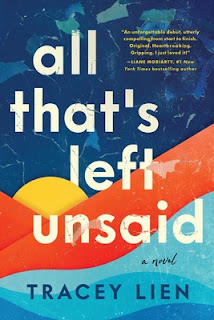
Review: All That’s Left Unsaid (by Tracey Lien)


My Rating:  5 stars

When I first read the premise for Tracey Lien's debut All That's Left Unsaid, I knew this was a book I wanted to read.  Comparisons to some of my favorite authors (Liz Moore, Celeste Ng, Brit Bennett) aside, I was intrigued by the case at the center of the story:  17-year-old Denny Tran attends a dinner at a local restaurant in Cabramatta, Australia (a suburb in Sydney) with his friends, but before the night is over, he is brutally murdered in plain sight of over a dozen witnesses, yet all of them claim not to have seen a thing.  The Tran family is devastated, but faced with an indifferent police force in a refugee enclave where the proliferation of drugs (specifically heroin) as well as violent crime have become commonplace, Denny's parents seem to have no other recourse but to accept the "bad luck" of their beloved son's murder.  But Denny's sister Ky refuses to let things simply get swept under the rug.  Desperate to assuage her feelings of guilt for leaving the family in order to pursue her own life in Melbourne (an act akin to "abandoning" the family and is severely frowned upon in traditional Asian households), Ky returns to Cabramatta and, after her brother's funeral, decides to seek out and interrogate each of the witnesses herself in order to find out the circumstances behind Denny's murder.  With each person she speaks to, Ky gets closer to understanding what happened to her brother, but at the same time, she discovers the myriad complexities and difficulties of navigating the path to justice and closure for her family in a community where its citizens are mostly resigned to their fates.

There was honestly so much to unpack with this story that it is impossible to cover every angle in a brief review such as this one (personally, I highlighted so many things in this book that were significant to me, it would take me pages and pages to parse all of it).  I will attempt to relay a few thoughts that stood out, but I encourage people to actually read this book in order to get the full experience.  

I do want to start off by saying that this book is technically incorrectly classified under mystery / thriller.  While it's true that the plot overall revolves around unraveling the "mysterious" circumstances behind Denny Tran's murder, it quickly becomes obvious (a chapter or so into the story, in fact) that his death is actually the trigger point for a deeply complicated and intricate exploration of community, society, class struggle, immigration, culture and assimilation, systemic racism, family bonds, parent-child relationships, generational trauma, mental illness, abuse, etc (and that's just scratching the surface).  The "mystery" itself was easy to figure out, which essentially rendered the ending anti-climactic, but the gut wrenching process of getting to that point was really the crux of what made this story work so well.  With its "social commentary" angle, I feel like this would've fit more appropriately into literary fiction, though from a time and place perspective — Cabramatta (which was an actual place in Australia) in the 1990s, during which time there truly was a heroin epidemic — there was also a historical element to the story as well that I didn't expect, but made the story even more compelling.

Before I go into talking about the characters, I wanted to comment on the title and structure. This book actually has one of the cleverest titles I've ever seen: it complements the book perfectly because when we peel back the layers, the story is essentially about "the many things that are left unsaid" by every character in the book — not just the witnesses from that night, but also the parents, Denny, and even Ky herself.  So in this sense, there is a deeper meaning to the title that can only be understood after reading and reflecting on the entire story.  Structure-wise, I love how the narrative alternated between various perspectives — sure, we got Ky's perspective primarily, but there were also chapters narrated from the perspectives of the witnesses as well as Ky's parents.  Through these chapters, we were able to get the backstories to the various characters, which helped us understand what ultimately drove each character's decision that fateful night.  Structuring the narrative this way not only made the story more powerful and poignant, it also helped make the characters realistic and relatable, which I felt was very important to this story overall.

Speaking of the characters, I truly appreciate the brilliant job that the author Tracey Lien did in the area of character development, especially with Ky and Minnie.  Reading this book was actually quite an emotional roller coaster for me because of the resonance I felt with the characters and so much of what they went through.  With Ky especially, I saw so much of myself in her — from her struggles with  identity and acceptance, to her analysis of her own shortcomings and insecurities, her feelings of anxiety related to the environment in which she grew up, and most significantly, her relationship with her mother.   I've always been drawn to stories about parent/child relationships, but those between Asian mothers and their daughters are especially resonant with me because of my cultural background and the hope that reading about these relationships will help me navigate the complex dynamic that exists there.

One of the other things I loved about this book was how, through the character of Ky (and Minnie to some extent), Lien so accurately expressed the realities of life for many Asian women like myself — daughters of immigrants (and/or refugees) who may or may not have been born in the Western countries where we grew up and currently live — and how many of the conflicts that we constantly deal with, be it the cultural expectations or the societal pressures that come with being Asian and female, greatly inform how we end up interacting with our parents (and with others as well).  I wanted to share the below passage from the book, which blew me away when I read it because it hit the nail on the head and made me feel "seen" in a way that so few books I've read in the past have been able to do.

"To anyone else, [his] reason would have been baffling. But Ky understood. She hated how well she now understood. After all, hadn't she kept every hurt she'd ever experienced from her own parents? Hadn't she hidden the bullying, the name-calling, the cruel acts of strangers, the times she'd been told to go back to where she came from, the ching-chongs, the pulled-back eyelids, the blondies with the Cabbage Patch Kids, the way she was forced to play the monster, the way she was asked why she couldn't just take a joke, the times she was told that Asian women were ugly, kinky, docile, crazy, nerdy, unworthy, the way she was dismissed by men, the way she was dismissed by white men, their comments about what Asian women were and weren't, what Asian women could or couldn't be, the way she smiled with her tongue pressed against her teeth even as an ache beat in tandem with her heart—hadn't she hidden all of that? And hadn't she lived her own ambitious, exciting, anxious, uncompromising life while knowing that she could never, ever, ever, ever tell her parents about what she had been through? Because knowing would break their hearts. Because she had to help them believe that their sacrifices had paid off. Because she had to help them believe that moving to a country where they didn't speak the language and weren't seen as individuals had been worth it. Because she had to convince them that they'd done right by their children, that no one had failed, that no one had been let down, that they were one of the lucky ones who'd followed the path and found success. It made perfect sense. You lied to protect. You lied because of love."

This is a book I definitely recommend and will likely want to re-read myself at some point. However, with that said, a word of warning that this is not going to be an easy read  — it is sad and heart wrenching, it presents truths about our society that may be difficult to face, and it may take you places that you would rather not be, especially with some of the things going on in the world at the moment.  But is is a worthwhile read — I would even say that it's a necessary read — for those who are up to it, of course.  This was a fantastic debut and I definitely look forward to what Tracey Lien has in store for us next.

Received ARC from William Morrow via NetGalley.

Monday, September 5, 2022

Review: The Ways We Hide (by Kristina McMorris)

My Rating: 4 stars

I have most of Kristina McMorris's works on my TBR, though so far, I've only had a chance to read two of her books — this book, her newest novel The Ways We Hide, and her previous one, Sold on a Monday, which came out back in 2018. While I have every intention of getting through McMorris's backlist at some point, I also don't want to miss any of her new works — which is why, as soon as I saw that she had a new book coming out this month, I requested an ARC before even reading the summary of what the book would be about.  After I got approved, I went back and read the blurb, which made me even more intrigued and excited to read the novel.  While I've read plenty of books set during World War II and covering various themes, one that I haven't come across is exactly what McMorris's new book explores:  the role of magicians / illusionists in the war effort.  Up until this point, I've always thought about magicians as entertainers, never realizing that there were very practical ways they could put their skills to use during the war, such as helping to design escape plans and contraptions or other gadgets that could hide things such as maps. This was a fascinating concept to me and an angle not often explored in WWII-themed fiction.  Not only that though, in terms of this particular story, the illusionist is a woman (the main character Fenna Vos), which is even more rare given the time period and the prevalent society conventions at the time.  

From a historical perspective, McMorris did a great job relaying the various elements related to real-life events and people, as well as establishing an atmospheric sense of time and place. I remember reading somewhere that McMorris mentioned this is one of her more ambitious novels to date, which I can totally see, as this one actually covered quite a bit of ground, with a time period spanning 1928 to 1945, a setting across three different countries (United States, England, the Netherlands), and a multitude of historical events / people covered (which I didn't actually realize until I read her Author's Note at the end of the book).  The meticulous research she did in preparation was obvious in the way she was able to utilize so much descriptive detail throughout the story, whether in reference to historical events and people, or even the gadgets created for military use.  Also, with Fenna's background as the daughter of Dutch immigrants and so parts of the story revolves around the Dutch community she grows up in, I ended up learning a lot in that area as well.

In addition to the story being well-written, the characters were also well-drawn, with Fenna written in a way where, as readers, we can't help rooting for her through all the hardships.  With that said however, I honestly found it difficult to connect with her on an emotional level — which is strange given the entire story was told from Fenna's first person point of view, so we are privy to all her inner thoughts and feelings.  I think part of the reason for this is because, for me, some parts of the story ended up focusing a bit too much on Fenna's romantic relationship with Arie, to the point that it drove a large part of Fenna's actions and decisions during a certain portion of the story.  Normally this wouldn't be a problem, but given the premise of the story and the highly dangerous situations she often found herself in, some of her actions came across as irrational and illogical.  While the romance piece wasn't overwhelming compared to the rest of the story, it was a little distracting for me because I was expecting more focus on the historical piece and how Fenna uses her skills as an illusionist and escape artist in her work with MI9.  This was also the main reason I ended up rating this 4 stars instead of 5, as I felt like the direction of the story strayed a bit near the midway mark and also, the emotional connection was lacking.

Overall, I definitely liked this one quite a bit and recommend it as a worthwhile read, especially for the different and refreshing angle it presents in terms of WWII historical fiction.  

Received e-ARC from Sourcebooks Landmark via NetGalley and print ARC via BookBrowse First Impressions program.