Wednesday, November 15, 2017

Review: The Storied Life of A.J. Fikry (by Gabrielle Zevin)


My Rating: 4 stars

Charming.  Sweet.  Sad.  Funny. Heartwarming.  Heartbreaking.  These are the first words that came to my mind when I finished reading Gabrielle Zevin's delightful gem of a book The Storied Life of A.J. Fikry.  I had actually bought the paperback version of this book several years ago (the Target Book Club version, complete with a special letter from the author and a question/answer session in the back), but never got around to reading it due to life getting in the way.  It wasn't until this year when I decided to participate in an A to Z author challenge on Goodreads and I needed to find a book to fill the "Z" author slot that I found the perfect opportunity to finally read this book.  I'm glad I did, as I ended up really really enjoying this wonderful little story about a curmudgeonly middle-aged bookseller named A.J. Fikry whose life changes dramatically when he decides to open up his heart and let love in its different forms enter it.  I found it difficult not to be charmed by the characters in the story and drawn to them in a personal way, as though I were reading about old friends I hadn't seen in awhile.  I loved the Fikry family, loved all their quirks and eccentricities, but most of all, loved their unbridled affinity for books and reading.  This was truly a "bookish" family in every sense of the word and I wanted nothing more than to be able to spend more time with them and hear their thoughts on books and of course life itself.  And herein lies my one little complaint about an otherwise wonderful book:  as a reader, the time I got to spend with A.J., Amelia, and Maya was way too short – some of the events went by way too quickly and I felt as though I had missed something (i.e. I was reading about Maya as a toddler and then a few pages later she was a grown teenager – I felt like I missed a huge chunk of her life), that I was somehow shortchanged a bit by not getting to share in parts of their lives that were quite significant….goes to show just how invested I was in the characters and the story. 

To be honest, I had actually never heard of this book or its author back when I bought this 3 years ago.  What compelled me to pick out this particular book amongst the rows and rows of choices at the store was, quite simply, because I saw on the book jacket that this would be about a bookseller and his book store.  Though this book turned out to be much more than just a story about a bookseller and his books (it was also very much about the power of love, redemption, unconventional relationships, the impact of technology, writing and its close link to reading, etc.), the book lover in me couldn't help losing myself in the fictional book world that Zevin had created in the form of Island Books, which was also A.J.'s home.  The fact that I was also familiar with most of the titles and authors mentioned in the story made reading this book an extra special experience for me!  It was a lot of fun hearing various characters' takes on certain books, especially A.J.'s – I didn't agree with his opinion at times but that was fine, as it didn't take away from the enjoyment of the story at all.  The writing was simple, yet profound – easy to understand and easy to connect with, yet not without its fair share of meaningful quips and dialogue that put me in a reflective mood at times. 

Overall a delightful book, one that will definitely be going on my favorites shelf!  Highly recommended and a definite must-read for all book lovers!  

Saturday, November 4, 2017

Review: Where the Past Begins: A Writer's Memoir (by Amy Tan)


My Rating: 3.5 stars rounded up to 4 stars

When I first learned that I had been approved for an ARC of Amy Tan’s new memoir, I was excited, as I’ve enjoyed quite a few of Amy’s books and count The Joy Luck Club as one of my favorites.  Reading the summary, I understood going into it that this would be a memoir where Amy talks about many of the things that influenced her writing over the last 3 decades, with emphasis on her family’s history and her own cultural heritage, both of which have served as a basis for her novels.  While I would say yes, this memoir did deliver in terms of what was laid out in the summary, it did so in a way that I didn’t quite expect, which impacted my overall enjoyment of the book as a whole. 

In her memoir, family history was conveyed via the various mementos and keepsakes Amy finds – old photographs, letters, documents, newspaper clippings, etc. – all of which opened up the floodgates of her memories of her childhood, her relationship with her parents, her brothers, her extended family and relatives in China, some of whom she never really got to know.  Digging deep into the past, Amy describes in candid detail the story of her maternal grandmother’s life in China (the differing versions told to her by her mother and by relatives) and the impact this had on the life her mother ended up leading as well as the type of person she eventually became – the significance being how greatly this impacted the next generation, specifically Amy and the books she ended up writing.  I found this part of the book fascinating and most enjoyable.  But then, in the middle of all this history, entire sections are inserted that appear to be excerpted from Amy’s journals -- random segments that seem to be (somewhat philosophical) self-reflections on her writing, tangents from her imaginative mind, ideas she had jotted down over the years as well as parts of stories that she had written that never got published. For me, these journal excerpts were the parts of the book that I didn’t expect and in fact, broke the flow of the narrative about Amy’s life and her family, which affected my ability to enjoy this book as much as I would’ve liked.  There was also a chapter that consisted entirely of letters between Amy and her editor, letters exchanged during the writing of The Valley of Amazement – while the letters were interesting and at times fun to read, I felt that they were a bit of a distraction and, like the journal entries, broke the flow of the book a bit.  Of course, it didn’t help that I haven’t yet read The Valley of Amazement, so much of what was said about the novel was lost on me – perhaps later, after I read the book, I can come back to this chapter, during which time I’m sure I would be able to appreciate this chapter better.

In addition to giving us insight into her family’s history and past, Amy also revealed many of her personal struggles, some of which I was surprised to find out about, such as her having epilepsy and the periodic lapses in her brain being able to function properly, also the fact that she suffered from depression that stemmed largely from her tragic childhood and a family history (on her mother’s side) of suicidal tendencies.  There were also the instances where she narrowly escaped death several times, all of which were described in such detail that it made my heart stop a few times.  I appreciated all the details and stories that Amy told about her own life as well as those of her family, but what appealed to me most was Amy’s depiction of her relationship with her mother, which was so vividly described in here (the theme of mother-daughter relationships is one of the things I love most about her novels – the ones that I’ve read, that is).  There were so many aspects of Amy’s childhood and upbringing that I was able to relate to, but most of all, it was her relationship with her mother that had me floored because of the striking similarities to my relationship with my mom -- many of the experiences Amy described about the way she and her mother often interacted, I had actually experienced the same things growing up, so I knew exactly what she was talking about when she described her feelings and reactions to situations that had occurred.  I was also shocked at some of the similarities in background with our parents (i.e.: my mom is also Shanghainese and came from a well-to-do family, also a beauty in her youth who lived a privileged life but left all that behind to start over again in another country; my dad was also born into a Cantonese family with an ancestral home in Guangzhou and also came from a large family, with him being the oldest of 10 children).  My parents’ histories weren’t as tragic of course, but many of the cultural and emotional nuances that Amy and her brothers experienced as a result of being raised in an immigrant Chinese household parallel the experiences my brother and I had -- also the pressure this caused on the entire family was similar (i.e.:  the struggles with assimilating to a completely different life in a foreign country, constantly having to live up to certain expectations, the resentment towards having to give up so much in exchange for a way of life that didn’t turn out as expected, etc.).  It is this personal connection and also the emotional impact from reading Amy’s story that made me round this up to a 4.  I greatly admire Amy and her mother’s strength, resolve, endurance, and most of all resilience in the face of all the tragedy and loss their family suffered.  What is also admirable is Amy’s continued dedication to her mother after the death of her father and brother – a dedication that continued to endure despite all the arguments and the hurts and the emotional pain inflicted (whether intentionally or unintentionally).  The chapter where Amy described her relationship with her mother during the last years of her mother’s life, when she was suffering from Alzheimer’s and could barely talk or move, up through the days of her death, truly moved me to tears.  That chapter alone reinforced for me the power of love and family and its ability to put previous grievances and wrongs suffered into perspective. 

Despite the issues I had with the format (if it had been better organized instead of all over the place, I think I would’ve given this book a solid 4 stars, maybe even higher), I would still recommend this memoir to Amy’s fans and/or anyone who has enjoyed her novels.  The writing is wonderfully descriptive in many places and quite a few passages were beautifully rendered.  The 80% or so of the book that talked about her childhood, family history, and their influences on her writing and in shaping who she became, really pulled me in…the rest, not as much, but overall this was still a worthwhile read.  Also, knowing what I know now about the influence of her family background in her writing, this makes me want to go back and read/re-read Amy’s novels in the context of what I learned, as I’m sure her novels will take on a whole new meaning for me now.

Received advance reader’s copy from Harper Collins / Ecco via Edelweiss

Monday, October 23, 2017

Review: Seven Days of Us (by Francesca Hornak)


My Rating: 3.5 stars

When I first read the premise for this story, about a dysfunctional family quarantined together for seven days over the Christmas holiday, it sounded like it would be an interesting tale, albeit not a very original one.  The Birch family must undergo a quarantine after the eldest daughter Olivia, a doctor, returns from a stint treating the deadly Haag virus in Liberia.  Each member of the family has a different attitude toward the quarantine:  the father Andrew, a restaurant critic for known for his sarcasm and dry wit, is accepting of the quarantine but unsure what to expect due to his rocky relationship with Olivia, a daughter he was never close with and hardly ever spoke to;  the mother Emma, who hails from one of Britain's elite families, is the penultimate "loving wife and mother" and is delighted to have her eldest daughter back for her to dote on; Phoebe is the youngest sister, a woman in her twenties, engaged to be married, yet constantly acts like a defiant teen, self-centered, self-absorbed,  and fiercely reliant on her parents to "take care of her" – having been the "only daughter" for so long due to Olivia rarely ever coming home, Phoebe resents her older sister for upending her life through having to go through this quarantine.  All of them harbor secrets that they don't want other members of their family to find out and they go to great lengths to keep those secrets hidden, but this will prove to be a difficult task given that the family will have to spend the next seven days together in isolation, virtually cutoff from the outside world.  Aside from the Birches, there are two other major characters who factor into the story – Phoebe's fiancé George, whom we find out from the getgo is essentially a jerk, and Andrew's long-lost son Jesse, a filmmaker from Los Angeles who takes the chance of traveling to Britain on a whim in the hopes of finally meeting his birth father.  When both of these characters unexpectedly "crash" the Birches' quarantine, the result is chaos and drama, with one surprise after another threatening to turn this already dysfunctional family's lives upside down.

I would characterize this book as an "okay" read – it was entertaining and the story was engaging enough that I found myself wanting to turn the pages quickly so I could find out what happens to this family, even though, to be quite honest, I didn't really like any of the characters all that much (except for maybe Jesse, whom I found least annoying and maybe even borderline endearing).  With that said though, I do appreciate that the author made the characters realistic, with each one having their flaws and personality quirks and making mistakes, not unlike people we may know in real life.  The main issue I had with the book (hence the 3.5 rating) was in the predictability of the plot as well as the overabundance of "coincidences" which made the story overall a little less believable for me.  There were a few situations that I felt were too contrived and some plot points that didn't really make sense, which detracted from the story a bit, for me at least.  I also wasn't emotionally invested in any of the characters (probably because I disliked most of them), which made it hard for me to feel anything for the characters, even with some of the serious issues they go through.  I actually felt a bit like an outsider looking in on this family and the various situations they were going through.  Perhaps this is where the writing could have been tightened up a bit – like maybe make the situations less repetitive or add a little more depth to the story and the characters.  It's kind of hard to explain – I really wanted to care about these characters, this family, but couldn't really get into it for some reason.  One of the things I did like though was that each chapter was short and also narrated alternately by each of the characters, which made it a quick read while still being able to get a glimpse of each character's perspective.

Overall, this book was compulsively readable and entertaining, but a bit lacking in depth.  There were quite a few very "serious" issues the book touched upon, but none of it dealt with in a heavy-handed manner, which I guess could be good or bad depending on the person reading the book.  I personally preferred a little more depth but that's just me.  This was still a relatively good book though -- a quick, light read that was engaging and even a bit fun at times, despite its dramatic undertones.

Received advance reader's copy from Berkley New York via Edelweiss

Tuesday, October 17, 2017

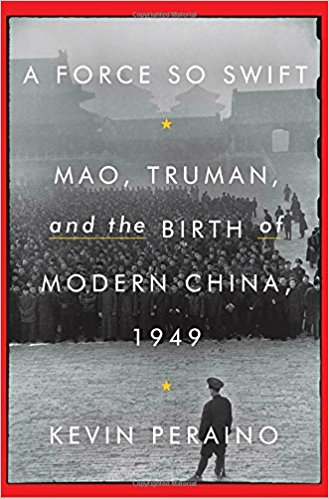
Review: A Force So Swift: Mao, Truman, and the Birth of Modern China (by Kevin Peraino)


 My Rating: 3 stars

I struggled a bit with rating this book, mainly because this book turned out to be very different from what I expected.  I'm quite selective when it comes to non-fiction books, since I know it generally takes more effort on my part to concentrate and focus on what I'm reading due to life's many distractions.   When I see a non-fiction book on a subject that piques my interest, I pick it up hoping that the information will be presented in a way that is engaging and insightful. I'm a bit of a history fanatic and love learning new things, so I tend to gravitate toward books that have a historical element to them.  While this book definitely covered the history aspect well, the part that made it difficult for me to get into was its heavy focus on politics.  I've always viewed politics as a complicated game with constantly-changing rules and a playbook so complex that only those players well-versed in its language have a decent shot at success.  I'm not one of those players and never will be.  I know enough about the basics to help me get through life, but that's about it – most politics go way above my head and to be honest, I'm fine with that, as I have no interest whatsoever trying to understand it.  It's no surprise then that I try to stay away from books that are heavy on politics and this is why Kevin Peraino's A Force So Swift: Mao, Truman, and the Birth of Modern China didn't really work for me.

The book recounts the one year timespan from when Harry Truman starts his second term as President of the U.S. in 1948 to the rise of infamous Communist dictator Mao Zedong and his establishment of the People's Republic of China in October 1949.  Historically, the author covered quite a bit of ground, starting from the end of the Second World War and its effect on the various countries that were involved (specifically the countries that formed the Axis and Allied Powers during the war), running through some of the major events that occurred during that time and the various players involved.  There was also a bit of back history about China, the rise of Generalissimo Chiang Kai Shek and the Soong family, Mao Zedong's early years and his role during the war, the Japanese occupation of China and its aftermath, etc.  – it also touched on some of the cultural differences between China and the U.S. and the basis for these differences from history….this first third or so of the book that dealt with history and culture I absolutely enjoyed.  However, after that, the book started to focus more on the American side of things – more specifically, the intricacies of American politics and development of foreign policy during the Truman administration, details about the political players and strategists who shaped the U.S. policy toward China and the rest of the Pacific, the roles that Europe and also Russia played, etc. – this is where the book started losing me and after I dozed off a few times while reading, I decided to skim my way through the rest of it.

I ended up rating this book 3 stars because it was actually very well-written and well-researched, plus the history and culture parts were really good, it's just that I didn't care for the minutiae with the politics, which unfortunately was majority of the book. For someone like me who is not into politics, I found this book a bit too tedious and way too long (my version came in at a little under 300 pages, with nearly 100 pages of notes/references in the back). Overall, this is a good book that I'm sure those who are into politics will find fascinating and also will learn a lot from it (in fact, our current leader in the big white house (and his staff too) should probably read this book so he understands the history behind our relationship with China and why he can't say the stuff that he has about China and Taiwan the past couple months and not expect to ruffle some feathers – as an added bonus, there's some stuff about North Korea in here too!).

Received advance reader's copy from Crown Publishing via Penguin First to Read program.

Thursday, October 5, 2017

Review: Don't Let Go (by Harlan Coben)


My Rating: 4 stars

I don’t read a whole lot of police procedural books and I had actually never heard of Harlan Coben before – however I had heard some good things about this book from a few Goodreads friends and the summary sounded interesting so when I saw it available for download on Edelweiss, I decided to try this book out.  I’m glad I did so because this one ended up being a really good book that was immensely readable and entertaining.

Napoleon Dumas (“Nap” for short) is no ordinary police detective.  Sure, he’s got good instincts and a keen eye for detail and he absolutely excels at what he does – that is, investigating cases.  But he is also a vigilante of sorts, a guy who is not afraid to put his career and reputation at risk in the name of justice.  The first time we meet Nap, he is beating up some guy named Trey, hitting him repeatedly with a baseball bat, eventually breaking his leg and landing him in the hospital.  We find out a few chapters later why Nap beat up this random guy he had no connection with and it turns out to be for a “noble” cause, but still, as a cop, it isn’t something he should be doing. But Nap doesn’t really care, as he knows that the beating can’t be traced back to him, since he covered his tracks well, plus the punk he beat up wouldn’t want to make a big stink out of it anyway for fear of incriminating himself.  Ever since his twin brother Leo’s tragic death during their senior year in high school 15 years ago, Nap has been an emotional wreck, exacerbated by the fact that his girlfriend Maura, the love of his life, also disappeared around the same time.  From the day the cops found Leo and his girlfriend Diana lying dead on the railroad tracks, apparently run over by a train, Nap refused to believe that the deaths were merely an “accident,” the tragic result of two reckless teenagers stoked up on alcohol and drugs doing something careless.  For 15 years, Nap is relentless in his search for the true reason why his brother died and also why his own girlfriend ran away.  When a fellow cop with a connection to Nap and his brother’s past is gunned down in another district, Nap is pulled into the investigation and finally has a chance to find out the truth – but at what expense?

This book drew me in from the opening scene and I found it difficult to stop reading.  From the beginning, it was already obvious that Nap would be an interesting character, an anti-hero of sorts -- he was unconventional, irreverent, and had no qualms about blurring the lines between right and wrong, a guy with more faults than anyone cared to count…yet you couldn’t bring yourself to dislike him.  I actually liked Nap from the beginning, despite his many flaws, and was rooting for him the entire time that I was immersed in his story.  I also liked Nap’s sarcastic sense of humor, which had me giggling at times, especially during the scenes when he would face off against an adversary.   The rest of the characters were also well-drawn, supported by a story with substance and the right amount of mystery and intrigue to keep readers engaged.  Coben definitely knows how to write a good crime thriller, as there was a fair amount of twists and turns in this one but nothing too over the top.  Even though I was able to figure out the “whodunnit” piece relatively early, that did not affect my enjoyment of this book at all -- perhaps I am just weird, but when it comes to thrillers and suspense novels, I try to take the “going along for the ride” approach and not get too caught up in trying to figure out the plot or getting too ahead of myself. 

One of the things that made this book different from other crime novels is the emotional element, which Coben did a great job of working into the plot.  This was a story that packed an emotional punch, but wasn’t overdone to the point of overshadowing the plot.  There’s a certain balance that needs to be had between the characters, plot, the writing, the suspense elements, the emotional pull, etc.  when it comes to books in the thriller / suspense genre and not all writers are able to bring all the elements together in a way that still allows the overall story to flow naturally – Coben was able to do this and do it well!  Seeing how much I enjoyed this book, no doubt that I will be reading more of this author’s works sometime in the near future.  Oh and even though I am not a fan of book series, I absolutely wouldn’t mind seeing more of Nap in the future if Coben decides at some point to turn this stand-alone novel into a series. 

Received ARC from Dutton / Penguin Publishing Group via Edelweiss.