Showing posts with label published in 2023. Show all posts

Sunday, April 26, 2026

Review: A Living Remedy (by Nicole Chung)

My Rating: 4.5 stars

Nicole Chung’s second memoir is a poignant love letter of sorts to her parents, both of whom pass away less than one year apart – her father from diabetes and kidney disease in 2019, and her mother from cancer in 2020, during the height of the COVID-19 pandemic.  Chung’s grief is palpable as she recounts the tragedy of her parents’ deaths and her own helplessness in being able to do much for them, both due to financial hardship and physical distance. Mixed in with the pain of losing her parents – both of whom loved her deeply -- is the guilt that comes from feeling that she abandoned them by leaving behind the rural hometown that she grew up in as soon as she could, in pursuit of a life that couldn’t have been more different than what she had known.  Alongside that is the feeling of rage that followed Chung almost incessantly as she gradually begins to understand the role that deep-rooted inequalities in America’s healthcare system played in the premature deaths of both her parents, who were only in their 60s when they passed. In highlighting these disparities, Chung is not vindictive – instead, she lays out the challenges that her parents encounter with the system, and in so doing, not only gives voice to their experiences, but also provides an insightful look into the frustrations of a system that, in its deliberate complexity, is neither meant to be fair nor equal.

Chung’s account of her parents’ experiences especially resonated with me due to my own mother’s health issues, many of which are similar to her parents’: diabetes, kidney disease, breast and uterine cancer, high blood pressure, irregular heartbeat, just to name a few.  I understand the difficulties of having to navigate a complicated healthcare system that, at the end of the day, often times leads to disappointment and despair.  I could also relate to Chung’s worry for her parents as well as the guilt that comes from not being by her loved ones’ side when they needed her most.

This was a heartbreaking read, but also an insightful one that gave me so much to think about and reflect upon, both as it pertains to my own family situation as well as the overall state of the healthcare system in this country.  I definitely recommend this searing, honest memoir, especially the audio book version, which, even though not narrated by the author herself, was still powerful and poignant in its recounting of the everyday realities and struggles of ordinary people trying to live their lives.

Saturday, April 18, 2026

Review: Vera Wong's Unsolicited Advice for Murderers (by Jesse Q. Sutanto)

My Rating: 5 stars

I’ve been wanting to read one of Jesse Q. Sutanto’s books for ages, so of course I was overjoyed when one of my book clubs picked the first book in her Vera Wong series for our monthly read.  After reading so many “heavy” books in recent weeks, this hilarious cozy mystery was the perfect palette cleanser.  I honestly don’t remember the last time I laughed so hard (and so much) – it’s definitely not an exaggeration to say that this was the (literally) “laugh out loud” funniest book I’ve read in ages!

As the elderly protagonist of the story, Vera Wong is a busybody who is meddlesome and nosy and yes, sometimes downright annoying in the way she likes to stick her nose in other people’s business, but she is also competent, efficient, endearing (in her own way of course) and always makes the most mouthwatering dishes (oh and let’s not forget her special skill of brewing the most perfect teas).  Growing up in a Chinese household, I was surrounded by my fair share of meddlesome aunties, so Vera’s antics in the story were both familiar and resonant.  I recognized Vera’s bluntness and her tendency to speak brazenly but matter-of-factly about things without taking other people’s feelings into account; the way she charges head and does what she wants when she wants, all rules be damned; her constant nagging and critiquing of not only her son but also all the young people in her orbit, though not in a grating way like the typical “tiger mom” but rather in a genuinely caring and protective “mama bear” way.  I love how Sutanto portrayed Vera in this realistic, yet nuanced way – on the one hand, Vera is a very traditional Chinese mother, yet on the other hand, she is also mindful of the younger generation’s mainstream cultural phenomena Tik Tok, Google, Buzzfeed, etc.  Indeed, I found the funniest scenes in the story to be those where the younger folks are shocked by Vera’s knack for discerning things that they didn’t think she would understand.  I also laughed so hard at the scenes where the young people in the story are simultaneously flustered and a tiny bit scared of Vera, yet they are also in awe of her and can’t help gravitating toward her, despite the obvious differences in the ways they see the world.  On the surface, the friendship between this elderly Chinese grandma and the young twenty/thirty something characters shouldn’t really work (because of the generation gap and all), but in this story, it not only works, it’s also beautifully rendered.

For me, being familiar with the culture also made this an especially engaging reading experience, as I was able to pick up on things that others might not have – such as the difference between the spelling of Vera’s last name (“Wong” versus “Wang”), for example.  I love being able to recognize these types of little details in stories – like finding Easter eggs – which in my opinion, makes the experience much more fun.

This was a delightful, heartwarming, and absolutely hilarious read – one that I absolutely recommend without question.  I’m looking forward to reading the second Vera Wong book (which I have on my shelf) as well as the Aunties series, which I heard is also excellent.  Sutanto is one of those authors who writes in a variety of genres – from cozy mysteries to thrillers to literary and contemporary fiction, as well as young adult and middle grade books.  I admire authors who are able to write across genres like that, so I’m definitely interested in checking out a few of those books as well.

Sunday, January 25, 2026

Review: Being Henry: The Fonz...and Beyond (by Henry Winkler)

My Rating: 4 stars 

As I continue my audiobook journey this year, I’ve been very selective in terms of choosing which memoirs (especially celebrity memoirs) to read, as there are way too many of them out there and quite a few of them don’t interest me in the slightest.  I’ve had Henry Winkler’s memoir on my TBR for quite some time though, as it was recommended to me by a few book friends who suggested listening to the audio version narrated by Henry himself.  It makes sense then, that when I rekindled my relationship with audiobooks at the end of last year, this book was one of several on my audio shortlist that I wanted to make sure I prioritized.  And yes, this memoir turned out to be every bit as delightful and funny as expected!  I can definitely see why Henry’s memoir won the Goodreads Choice Best Humor award back in 2023 when the book first came out, as I found myself chuckling at certain moments, but best of all was hearing Henry himself laughing during those same moments.

Prior to reading his memoir, I had no idea how charming and funny Henry could be, as I was born in the late 1970s so Happy Days was kind of before my time -- though I was familiar with the show, as I watched it through reruns in syndication in the late 80s/early 90s, I of course wasn’t around when the show was at its peak in the mid-70s, so I never really “followed” Henry’s career as I did other sitcom stars.  Like many others, I only knew Henry as “The Fonz” so reading his memoir and learning about his life and career beyond that one iconic role has been an especially insightful experience.  It was interesting to hear about Henry’s long-time concern about being typecasted and the impact that had on him being able to find acting work, which led to him exploring other career paths such as producing, directing, and even becoming a children’s book author (now I want to check out his Hank Zipser books, as they sound so delightful).  With Henry’s memoir, the most nostalgic moment for me was hearing him talk about his experience producing one of my favorite TV shows, MacGyver (the Richard Dean Anderson version from the 1980s/1990s), which, though I knew back then that he was an executive producer on the show, I completely forgot about it until he mentioned it (as much as I miss that show, I have no interest in watching the recent reboot of the series).

In terms of Henry’s personal life, I was surprised to hear how poorly he was treated by his parents and sibling and the lifelong strained relationship he had with them as a result (when his parents died, he didn’t even want to go to their funerals at first, which says a lot about how toxic the relationship was).  As heartbreaking as it was to read about this struggle (which, I will be honest, those of us who have strained relationships with our own parents can probably relate to), I was glad to hear that, in the end, this turned out to be a blessing in disguise because it made him vow to not only be a different kind of parent to his own children, but also as a person, actively strive to be the opposite of what his parents were (now I understand why he is regarded as the nicest man in Hollywood and is so beloved and respected in the industry).  My favorite part of Henry’s memoir is when he talks about his relationship with his wife Stacey, to whom he has been married 47 years (at the time that this memoir was written) – given how the entertainment industry works, not only is it rare to see such a long and loving marriage, it’s also wonderful to see how much Henry adores and respects his wife.  It was such a treat to get to hear Stacey narrate parts of the audiobook alongside Henry and give her own perspective on things – I actually ended up adoring Stacey as well and can definitely see why she is such a perfect match for Henry.

I really enjoyed this memoir and appreciated learning so much about Henry Winkler – specifically about his personal struggles and, more significantly, how different he is from the personas he portrays on screen.  If I wasn’t a fan of his before, I certainly am one now!

Thursday, December 25, 2025

Review: If You Would Have Told Me (by John Stamos)

My Rating: 3.5 stars

I recently started getting into audiobooks because I was seriously feeling the overwhelm of having a mile-high TBR and I figured this would be a way for me to get through more books.  I had actually tried audiobooks several years ago, but the experience wasn’t good, so I had abandoned the effort.  However, recently, as I was trying to figure out how to get through more of my TBR, I decided to look into audiobooks more and came across some articles that talked about understanding your own audiobook style.  Something clicked in my brain and I realized that audiobooks didn’t work for me before because I was “reading” the wrong kinds of books via audio. 

In assessing my own reading style overall, I realize that I have some perfectionist tendencies which cause me to take an overly disciplined approach to reading.  This manifests in different ways for me, but mostly, it means that I need to be very focused and pay close attention to what I’m reading – an approach that works well for the types of books I’m usually drawn to -- i.e.: literary and historical fiction with gorgeous prose, contemporary fiction about relatable society issues, emotionally nuanced fiction that makes me both laugh and cry, etc..  I can’t read these types of books via audio because it’s hard for me to concentrate, as I am usually doing something else at the same time, which distracts me from paying as close attention as I need to in order for the story to sink in.  So based on this, I figured out that the best books for me to “read” on audio are ones where I don’t need to pay as much attention and, more importantly, I don’t need to hang on to every single word – for me, this means memoirs, essay collections, narrative nonfiction, and some genre fiction such as mystery/thriller titles with compelling plots. This has quickly become a life-changer for me, as I am able to get through so many more books than I would have been able to otherwise – I just need to make sure I choose the right books.

One of the first books I decided to read on audio was John Stamos’s memoir If You Would Have Told Me.  There are not too many Hollywood celebrities whose memoirs I’m interested in reading (in fact, I usually try to stay away from celebrity memoirs if I can help it, but that’s a discussion for another time), but as a huge Full House fan back in the day, I unsurprisingly put this on my TBR as soon as it came out.

I have to admit that I was a tad bit disappointed with this one, but I think that’s because I didn’t have the right expectations going into it.  In my mind, the character that John Stamos will always be most associated with is Uncle Jesse from Full House, so I was anticipating that there would be a lot of behind-the-scenes insights about his experience on the show that, essentially, made him a household name.  While Stamos does talk about his Full House days here, that is actually a relatively small portion of the book overall.  Aside from the expected biographical stuff about his childhood and family (which I did find insightful), the chapters about his career mostly focus on his relationship with the Beach Boys, comedian Don Rickles, and the other entertainment industry folks who had mentored him throughout his long career.  Since I had never watched any of Stamos’s performances outside of Uncle Jesse (though I knew of his stints on General Hospital and ER), I was admittedly less interested in these other aspects of his career, so I ended up zoning out a bit during some of those sections.

Overall, the sections I enjoyed most were the ones where Stamos talked about the life-long relationships he developed with the Full House cast and crew.  The chapter on the late Bob Saget was especially moving and well done and of course, brought tears to my eyes. I also enjoyed the chapter about Stamos’s experience working with James Earl Jones on Broadway (I never would’ve guessed that Darth Vader was once a mentor to Uncle Jesse, lol).  It was also heartwarming to read about Stamos’s close relationship with his parents and sisters, which was a nice departure from the typically strained and messy relationships that so many celebrities have with their families.

I’m glad I finally got a chance to read this and while it wasn’t what I expected, it was still worth the effort, especially on audio where I was able to get other things done at the same time.  Speaking of the audiobook, I had a bit of an interesting experience that I wanted to share.  One of the reasons I had decided to read this as an audiobook was because I was told that this would be narrated by Stamos himself, which I thought would help me get into the book easier. Maybe it has been too long since I’ve seen or heard John Stamos on TV so I’m not able to recognize his voice anymore, but the narrator honestly did not sound like him at all – in fact, for most of the book, I couldn’t help but think that perhaps my library copy of the audiobook was defective or something.  Also, some of the sections where Stamos talked about some of the shows he was in, it seemed like he was reading copy from a plot summary or something similar, as those parts sounded awkward and overly professional, like reading from a script perhaps.  But this could just be my novice experience with audiobooks – I think once I have more of them under my belt, these type of narration nuances will make more sense to me.

Saturday, April 27, 2024

Review: Only the Beautiful (by Susan Meissner)


My Rating: 4.5 stars

I’ve had Susan Meissner’s books on my TBR for quite some time, but it wasn’t until recently that I got the chance to read one of her books – and the most recent one at that!  Meissner’s latest Only the Beautiful is one of those books that has so much of what I look for in a truly excellent read:  a genre I love (historical fiction), a beautifully well-written and engrossing narrative, well-developed characters whom I could relate to and root for, meticulously researched elements incorporated seamlessly into the story, and a thought-provoking story arc with emotional depth that continues to stay with me long after I finish reading the book. 

With all that said, I have to admit that I was a bit hesitant to pick this one up at first, mostly because of the WWII setting, as I had read too many books with this setting in recent years and felt like I needed a break – but since I had agreed to read and review this one, I of course followed through with it and am glad I did, as this turned out to be a very different story from what I expected.  Rosie’s story in part 1 was truly heartbreaking and in all honesty, left me speechless, especially as I had no idea that eugenics was being practiced in the United States throughout much of the 20th century (nor did I know that there were actually laws that supported the practice).  I was also shocked to find out that the state of California (where I grew up and lived my entire life) was the site of the highest number of forced sterilizations in the nation up until the 1960s.  As heartbreaking as part 1 was though, Helen’s story in part 2 was even more so, especially as the parallels between what the Nazis were doing in Europe and what people in positions of power were doing in the United States became terrifyingly clear.

Reading about this history, I could not help but think about all the terrible decisions being made in our country in recent years that attempt to take away our right to choose what is best for ourselves.  As Rosie and Helen both ask at various points in the story:  Why do those in a position of strength get to decide what the best looks like?  Why is it that only the strong get to define what weakness is?  What gives those in power the right to decide who is worthy to be a mother or a father and who is not?  Who gets to decide that living with a disability means that life is not worth living?

There was so much in this book that was difficult to read about, yet I would still highly recommend it as a necessary as well as illuminating read. Books like this one remind me yet again how important it is to understand the connection between history and what is happening in our world currently, as well as how these things can impact our lives in ways both profound and subtle. 

As I await the next book from Meissner, I definitely need to go back and read her other books on my TBR (starting with the ones which I already have physical copies, of course).  Looking forward to more wonderful reads from her backlist!

Received print edition from Berkley via Bookbrowse.

Friday, December 1, 2023

Review: Good Bad Girl (by Alice Feeney)


My Rating:  3.5 stars


Having read all of Alice Feeney's previous books, I of course couldn't pass up her latest, Good Bad Girl, even if it already came out several months ago.  Ever since I read Feeney's debut Sometimes I Lie (which blew me away) back in 2017, she has been a "good-to" author of sorts for me when it comes to the thriller/suspense genre.  With that said though, her books since that debut have been somewhat of a hit or miss for me – only one has gotten close to the level of her debut in terms of story and ending "twist" (that would be 2021's Rock Paper Scissors); the rest were al largely enjoyable (and all were very well-written), but didn't grab my attention like the aforementioned two did.  For me, Feeney's latest book falls into the latter category – definitely not her best work, but not her worst either.


As this is a thriller where you want to go in knowing as little as possible, all I'm going to say about the plot is that the premise revolves around a "mystery with three suspects, two murders, and one victim."  While I'm not necessarily sure that I agree with this premise now having finished the book (the "explanation" of this in the story was a little bit of a stretch in my opinion), I guess it does work to describe the plot overall.  Speaking of the plot – this is one of those "slow-burn" stories told from the alternating perspectives of multiple characters, which adds some complexity, but the plot also meanders in places, which made it harder to maintain my attention at points. 


To be honest, this one didn't really feel like a thriller/suspense novel to me, at least not in the same vein as Feeney's earlier works that were chockful of twists and turns and usually had me at the edge of my seat anticipating what would come next.  Instead, this one seemed to focus more on the complexities of mother/daughter relationships as well as the notion that each person has both good and bad qualities that motivate our actions – while I appreciated these insights (and in any other book, probably would've liked to see these ideas explored more), I felt like it waxed a little too philosophical and ended up bogging the story down a little.   Perhaps this is also why the ending felt somewhat anticlimactic to me (though it could also be that I had already figured out how the different threads would come together by that point).


I would say that overall, this was enjoyable and I'm glad I read it, even though it didn't have all the twists and turns that I usually expect from Feeney's thriller/suspense novels.  The writing, as usual, is good though -- Feeney writes in a way that is smooth, flows well, and not choppy – which is why I like reading her books even if I'm not necessarily keen on the story.  I continue to look forward to her next book and will definitely read it whenever it comes out.

Friday, November 24, 2023

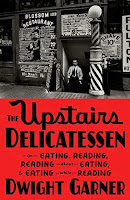
Review: The Upstairs Delicatessen (by Dwight Garner)

My Rating: 4 stars

This interesting memoir from New York Times book critic Dwight Garner came out last month and while it initially wasn't on my radar at all, I decided to pick it up when I saw what the book was about: reading and eating (perfect timing for Thanksgiving!). In this memoir, Garner writes about his "upstairs delicatessen" (a term borrowed from critic Seymour Krim) which refers to his memories involving his two lifelong passions — "reading about eating" and "eating while reading" (what a fantastic title/subtitle!!). Divided into 5 chapters (aptly titled Breakfast, Lunch, Shopping, Drinking, Dinner) plus an Introduction and Interlude, Garner writes enthusiastically about his experiences with his "twin joys" of reading and eating, but more than that, he also compiles for us a full-to-the-brim cornucopia of food (and eating) references and quotes from his broad range of reading over the years (his reading runs the gamut from books, poems, short story collections, essays, magazine and newspaper articles, etc.). Some of the writers and works he mentions are well-known, others I've honestly never heard of, but regardless of whether I was familiar with the works or not, it was still a lot of fun to read.

Literary references aside though, I also enjoyed reading about Garner's life and his "food adventures" growing up in West Virginia and Florida. I found the section where he talks about his relationship with his wife Cree especially fascinating given their completely opposite food-related backgrounds — she comes from a family of "food connoisseurs" (chefs and restaurant owners) who were all about fresh ingredients and growing their own food (he mentions that his wife grew up bringing leftover frog legs to school for lunch), while he comes from a working class family that pretty much ate whatever they found around the house (i.e.: bread laden with mayonnaise and cheese slices, potato chips, some red drink from powder mix, etc.). Despite these differences, their relationship not only works, but thrives — Garner relays their family's "quirkiness" in relation to food with such affection and humor, which I really appreciated.

Overall, this was a fun, delightful read that I highly recommend — though words of warning that some of the food that Garner describes as having eaten might make you feel queasy (personally, I will admit to feeling a tad grossed out when I read about the famous "peanut butter and pickle sandwich" that Garner describes his dad making for him, but that's mainly because I dislike pickles). With that said, the sheer volume of food-related anecdotes that he gathers in here is impressive, so if anything, picking this one up for those nuggets alone was well worth my while.

Monday, November 20, 2023

Review: A Man of Two Faces (by Viet Thanh Nguyen)

My Rating:  5 stars

As soon as I turned the last page of Pulitzer Prize winning author Viet Thanh Nguyen's new memoir, my first reaction was, well, silence because I was too awe-struck to speak.  I sat there for quite some time, reflecting on what I had just read (to say there was A LOT to reflect upon is an understatement), but also marveling at the brilliance that I had just witnessed.   Believe me when I say that this is no ordinary memoir — the content itself (with Nguyen's eloquent yet unflinchingly honest writing style) is powerful enough on its own, but the way he plays with elements of form throughout the book honestly just blew me away.  The formatting of the book is important here — the sections that mimic poetry, the clever use of white space, the different size fonts, the use of "TM" after certain words, the thoughtful (and careful) placement of words / phrases / sentences on the page to convey specific ideas, the shifting of voice and point of view, the interspersing of family photographs where appropriate, etc. (truly, I could go on and on) — all of this had the combined effect of creating a unique and powerful reading experience unlike any other.  I've read my fair share of memoirs over the years, but I've definitely never read anything like this one.

As I mentioned earlier, Nguyen writes eloquently, using language and prose in a way that captivates, yet doesn't come across as pretentious or highbrow.  In fact, Nguyen writes in such a straightforward, lucid manner that, at times, I couldn't help but feel taken aback by the brutal honesty of his words.  At the same time, I also resonated deeply with much of what he wrote (even though our backgrounds couldn't be more different). Case in point — I had actually received an advance copy of Nguyen's memoir and started off reading the e-arc, but barely a few pages in, I was already highlighting so many things that resonated with me, that I wound up getting a physical copy of the book instead so I could have something tangible in which to make notes (I ended up using an entire sleeve of colored sticky tabs because I found things I wanted to flag on nearly every page).  Something else that struck me with this memoir — Nguyen talks about a lot of very difficult topics in here (as he mentions himself at certain points, this is his family's story, but also a "war story"), yet he also infuses the entire narrative with a self-deprecating sense of humor — the net result being a perfect balance of serious and funny that made the "heavy" topics easier to engage with.  Personally, I found myself laughing and crying in equal measure while reading this book.

To be honest, I don't think any review will be able to do justice to the brilliance of what Nguyen was able to achieve with this memoir. I initially thought about including a few quotes in this review that especially resonated with me, but there were so many good ones that I had trouble picking only a few, so I decided not to include any.  Instead, I recommend anyone reading this review go pick this one up (a physical copy, as that's the best way to appreciate this memoir with such an unconventional structure) and experience it for yourself.  

Lastly, I wanted to put in a plug for Miwa Messer's interview with Viet Thanh Nguyen on her Poured Over podcast.  The conversation they had about this book was absolutely wonderful and inspiring — definitely a great supplement to the reading experience with this one! 

Received ARC from Grove Press via NetGalley.

Tuesday, November 7, 2023

Review: The House of Doors (by Tan Twan Eng)

My Rating: 4 stars

I've wanted to read Tan Twan Eng's works for years, ever since a few bookish friends of mine read both his previous award-winning novels and kept recommending them to me.  While I do have both of those novels on my TBR (as well as physical copies sitting on my shelf), I keep falling into the "too many books, too little time" trap and of course, in the end, I wasn't able to get to them (someday though, I am determined that I will get to all the books I've been meaning to get to!).  Anyway, I guess it shouldn't be a surprise then that when I heard Tan would have a new book out this year, I jumped at the chance to grab a copy, and while I was hoping to have read this one last month before it was actually released, getting to it now is better late than never.

One of the things I've heard that Tan is known for is the beautiful, lyrical prose that he utilizes to tell his stories.  While yes, there was definitely quite a bit of beautiful writing in this newest novel, it actually didn't permeate the entire story, at least it didn't feel so to me. I felt that some parts — especially those related to the Proudlock murder trial — were written in a simpler, more straightforward style that seemed to be a little bit at odds with the more descriptive and elegant prose in other parts. But then I later read in an article that with the trial segments, Tan was trying to hew as close to the real life unfolding of the event as possible, in which case, the more restrained, straightforward writing made sense. 

This is actually one of those books where there technically wasn't much action in terms of plot (a large part of the book was the main protagonist Lesley Hamlyn recounting a story to famous author W. Somerset Maugham) — yet at the same time, there seemed to be several threads running through the book that felt necessary to keep track of. 

Essentially, the story is a reimagining of Maugham's trip to Penang in the 1920s and what he learns while there becoming the inspiration for one of his later books, the short story collection entitled The Casuarina Tree (which was published in 1926).  While I'm familiar with Maugham as an author, since I've read a few of his previous works (my favorite of the ones I've read is The Painted Veil), I knew very little about his personal life, so I was curious how much of the way Tan depicted Maugham was fact versus fiction — which of course took me down the rabbit hole of reading up on Maugham after finishing the novel (it was fascinating to see how Tan incorporated the real life details about Maugham into the story).  Also, after finishing this novel, I immediately wanted to read The Casuarina Tree to see how Maugham actually wrote the story of the Proudlock murder and trail (which itself was based on real life events) and how much of it jived with Tan's version (I know, I'm a nerd with this kind of stuff) — though unfortunately, I haven't been able to get my hands on a copy yet.

One of the other threads that Tan wove into the book was a backstory involving the famous Chinese revolutionary Dr. Sun Yat Sen (who really had visited Penang at the time, but in a different year).  There were also other aspects of Chinese history that Tan incorporated into the story, such as the Taiping Rebellion and the fall of the Qing dynasty.  Given the dearth of English language novels in existence that talk about such lesser known aspects of Chinese history (and actually get the facts straight to boot), I definitely appreciated what Tan did here.  Even though this particular story arc was secondary (the main arc was Maugham's visit and the story Lesley told him), it was, in my opinion, the best written part of the book (and certainly my favorite out of the several threads throughout the story).

Overall, this was quite an ambitious novel with multiple threads that made the story a tad convoluted in places, but I still enjoyed it immensely.  As I mentioned earlier, I definitely need to track down a copy of The Casuarina Tree so I can study the parallels — after that, I might just dig up my copies of Tan's previous 2 novels and get started on them (time permitting, of course).

Received ARC from Bloomsbury Publishing via NetGalley.


Sunday, October 29, 2023

Review: The Leftover Woman (by Jean Kwok)

My Rating:  3.5 stars

Now that I have a little bit of a break from the demands of work and school, I am hoping to get caught back up on the new releases and book club reads that I had been neglecting over the past month.  One of those new releases is Jean Kwok's latest novel The Leftover Woman, which came out earlier in the month.  I had read Kwok's previous novel Searching for Sylvie Lee several years back and had really enjoyed it, so of course this book, her newest work, was highly anticipated. In the end, Kwok definitely didn't disappoint, as she delivered a solid, compelling story that proved to be both culturally resonant as well as thought-provoking -  though not without a few flaws.

At the center of the story are two women from completely opposite worlds.  Jasmine Yang is a young Chinese woman from a poor rural village who enters into an arranged marriage at 14 to a man years older than her. After suffering several miscarriages, Jasmine finally gives birth to a daughter, but not too long afterwards, is told that the baby died.  Jasmine is devastated — until she finds out that her husband lied to her and actually gave the baby up for adoption so that they could try for a son under China's strict One Child Policy. Determined to find her daughter, Jasmine plans an escape from her abusive marriage and eventually lands in New York through the help of "snakeheads" whom she has to figure out a way to pay back.  Meanwhile, in New York, Rebecca Whitney is an editor at a glamorous publishing house who is living the dream life — she has a prestigious family name and the accompanying wealth and privilege that comes with it, and she lives in a beautiful house with a handsome, talented husband aa well as an adopted daughter whom she adores.  But balancing a high profile career with the demands of marriage and motherhood is not easy and when a work-related scandal breaks out, Rebecca finds her perfect life slowly starting to unravel.  The story is told alternately from the perspectives of these two very different women whose lives end up colliding in unexpected ways.

I really appreciated the premise of this story, especially Jasmine's storyline about her struggles fleeing an archaic, patriarchal system and the choices she had to make once she was in America trying to find her daughter. Not that I didn't like Rebecca's storyline, but I just felt that it was less necessary — I would've liked to see Jasmine's story explored more, as there were opportunities there that were only touched upon.  I will be honest in saying that I preferred Jasmine's story arc and the direction that Kwok went with it (though there was potential for more as I mentioned earlier), whereas Rebecca's story arc felt typical of other stories that we've read before.

Plot-wise, I felt that the first half of the story dragged a bit and the buildup was slow — I definitely preferred the second half better, though the ending also felt too rushed (and there were some plot holes that weren't too believable). Despite the pacing issues though, I enjoyed this one overall — the cultural aspects were done well and the "twist" did take me by surprise (though it didn't blow me away to the point that I keep thinking about it like I've done with other twists).  

I don't want to say too much, since this IS a mystery / thriller after all, so it's best to go in knowing as little as possible (though I have to say that the story was more character-driven than plot-driven, so from that aspect, the thriller element was less prominent).  I definitely recommend picking this one up, especially if you're looking for a story that has mystery / thriller elements, but also emotional depth and poignancy.  I can't wait to see what Kwok comes out with next!

Received ARC from William Morrow via NetGalley.

Friday, September 8, 2023

Review: The Golden Gate (by Amy Chua)

My Rating:  3.5 stars

Amy Chua's debut novel The Golden Gate is an ambitious work of historical fiction that weaves together many threads spun around the murder of a politician named Walter Wilkinson at the Claremont Hotel in Berkeley, California in 1944.  Al Sullivan is the police detective on the case and he gets to work quickly, following one clue after another that mysteriously keeps leading him to the Bainbridge family (one of the wealthiest families in San Francisco) as well as another death that occurred at the same hotel 14 years ago.  As the investigation unfolds, several other possible "angles" emerge that attempt to throw Sullivan (and us as readers) off track, but of course, the truth prevails in the end.

This historical mystery was an enjoyable read overall, but due to the broad scope of issues (social, political, and everything else in between) that Chua tries to cover here, it felt like the story was all over the place at times. Chua also incorporated a lot of historical facts throughout the story, many of which were fascinating (especially to a history buff like me), but didn't seem to have much relevance to the plot.  In fact, there were moments where I felt like I was reading a history textbook rather than mystery novel (which felt even more awkward considering the sections with the most historical facts were largely narrated from Sullivan's first person perspective).  There were also large segments where Sullivan would go into spiels relating to his background — again, interesting, but felt kind of off-topic since much of it didn't seem to have anything to do with the case he was investigating.

The part of the story's structure that I thought worked really well was the deposition from the Bainbridge family's matriarch Genevieve, which was interspersed throughout the narrative. The way that these sections were written — with just enough information yet not revealing too much — combined with the other clues from the investigation, had me wondering and second- guessing certain things (as a mystery novel should).

Overall, this one was definitely entertaining, but I think it would've been more effective if the irrelevant historical facts were left out, as this distracted from the story at times.  With mysteries / thrillers, I prefer for them to be more tightly-plotted — this one went off on too many tangents, which made the plot harder to follow.  This was a good first effort though and I appreciate all the research that Chua put into this one.  I actually didn't realize until I read up on the author afterwards that Chua also wrote the nonfiction book Battle Hymn of the Tiger Mother — her 2011 memoir that I've had on my TBR for ages but still have not yet read.  I guess this is as good a reminder as any to find time to get to that one at some point.

Received ARC from Minotaur Books via NetGalley.


Sunday, September 3, 2023

Review: The River We Remember (by William Kent Krueger)

My Rating:  4.5 stars

I loved William Kent Krueger's previous stand- alone novel This Tender Land and since finishing that book, I've been highly anticipating his next one for some time. Though he did release 2 Cork O'Connor novels in between, I hadn't started reading that series yet, so I didn't read those 2 when they came out (I'm very particular when it comes to book series and prefer to start from the first book as much as possible).  Of course, it should come as no surprise then, that when I heard his newest novel, The River We Remember, would be another standalone, I knew I had to read it as soon as possible.  I'm happy to say that the wait was well worth it, as Krueger gives us another poignant, atmospheric, multi-layered story with complex, nuanced characters.  In the Editor's Letter at the beginning of the novel, Krueger's editor Peter Borland introduces the book this way:  "This is a spellbinding novel that asks big questions about justice, redemption, and the fragile ties that bind a community together. In this book more than any of his others, Kent shows us that heroes have flaws, villains have virtues, and our lives are made better when we can feel compassion instead of hatred for our enemies."  Such a fitting description that perfectly encapsulates this brilliantly-written story!

The story starts on Memorial Day 1958, in a small town called Jewel, located in Black Earth County, Minnesota, where the Alabaster River "runs seventy miles before crossing the border into Iowa."   When the body of Jimmy Quinn, the richest man in the county who also owns most of the land in the area, is found in said river, it sets off a series of events that profoundly changes this small rural community. The gruesome death triggers an investigation by the town's local sheriff Brody Dern (who is also the story's main protagonist).  As we follow the investigation that forms the "mystery" at the heart of the story, we soon come to understand that the narrative is actually much more complicated than what we initially thought.  In essence, this story is an exploration of life in a small, tight-knit community where things are never as simple as they seem and one event can cause underlying tensions to rise to the surface. Krueger covers a lot of ground here in terms of bringing to light many of the issues in society — such as the deep-seated prejudices resulting from the lingering effects of war, the country's history of mistreatment toward Native Americans and indigenous population, the divide between rich and poor, family conflict and dysfunction, abuse and trauma and grief, etc.  

There is a large cast of characters, all of whom are realistically portrayed in that they are flawed and morally ambiguous, with things in their pasts that they have to constantly contend with while dealing with present struggles that they try to overcome.  Also, as with most of Krueger's stories, the setting here — in the form of both time and place — plays a hugely important role in the narrative arc.  Even though it has been over a decade since the end of WWII, the wounds from the war still run deep in Black Earth County, which has the effect of shaping the attitudes and behaviors of its residents.  I mentioned the Alabaster River earlier, which has such an outsized role in the story that it can essentially be considered a character itself.  One of the things that always stands out to me in Krueger's works is his ability to incorporate the local landscape to great effect and also write about it in a way that makes us (the readers) care about it as much as the characters do.  I'm not much of a "nature" reader in the sense that I typically get bored with too much description of physical settings (i.e.: natural habitats and surrounding areas), but the way Krueger does it, I always find myself being drawn in — no doubt this is a testament to Krueger's powerful writing and storytelling.

Needless to say, I recommend picking this one up, though be forewarned that the book deals with some difficult topics, so trigger warnings abound.  Krueger fans definitely won't be disappointed with the masterful storytelling and the unforgettable characters presented here.

Received ARC from Atria Books via NetGalley.


Sunday, August 27, 2023

Review: The Invisible Hour (by Alice Hoffman)

My Rating:  4 stars

I had heard so many great things about Alice Hoffman's works, but didn't get the chance to read anything by her until now.  Hoffman's newest book, The Invisible Hour, is a beautifully written story that covers so much ground theme-wise.  It is about a mother's undying love for her daughter, about the freedom of choice and defying the restrictions that society places on women, about love, heartbreak, self-discovery, found families, and what I loved most of all:  the enduring power of books and the myriad ways they can affect those who read them.  I'm sure many an avid reader will be able to recall an example of when the right book came into their lives at exactly the right time that resulted in a profound change or impact in some way.  In the case of the main protagonist in this story, Mia Jacob, the book is The Scarlet Letter by Nathaniel Hawthorne — a book that not only (literally) saves her life, but also goes beyond that in its ability to provide profound clarity and meaning as the book accompanies her through her journey of self-discovery.

Hoffman weaves in time travel and magical realism to great effect here.  The first part of the story is set in an undefined "here and now" in Boston, Massachusetts, where Ivy Jacob, a young girl from a wealthy family, finds herself pregnant and alone after her boyfriend abandons her and her parents threaten to send her away as well as put the baby up for adoption.  Ivy runs away and ends up on a farm in rural Massachusetts, which turns out to be an oppressive cult called the Community, run by a charismatic but dangerous man named Joel Davis.  Ivy marries Joel and gives birth to her daughter, Mia.  The Community has strict rules and people who reside there are often subject to harsh punishments for the slightest infraction — punishments that usually involve public humiliation of some sort, such as having their hair forcefully cut or having a letter branded on their bodies.  When Mia commits the cardinal sin of reading books in secret (books are considered evil and are banned in the Community), she finds herself in an untenable situation where she must take matters into her own hands.  The second part of the story is set in 1837, in Salem, Massachusetts, and focuses on Nathaniel Hawthorne's life in the years prior to him writing the novel that would make home famous.  In part three of the story is where both worlds collide in ways that are interesting and unexpected, yet follow a trajectory that is careful about not altering history.

This was a book that I couldn't help being immersed in the entire time I was reading it, even though stories with time travel and magical realism aren't usually my jam.  I think much of this had to do with Hoffman's exquisite writing and brilliant storytelling, which wove the historical and fantastical elements together in a compelling fashion (though I have to say that I was a bit ambivalent about the ending).  When I finished the book, my first thought was to marvel at how Hoffman pulled this story off in a way that felt both magical and historically believable, while also incorporating timely commentary on societal issues.  Of course, this was also a wonderful tribute to books and reading. 

What a great first experience with Hoffman's works!  This definitely got me interested in reading her other books at some point.
Oh, also, for those who decide to pick this one up, there's a moving, gorgeously written Author's Letter at the beginning of the book that is absolutely not to be missed.  

Received ARC from Atria Books via Edelweiss


Saturday, August 19, 2023

Review: Happiness Falls (by Angie Kim)

My Rating:  3 stars

I have such mixed feelings about this book.  On the one hand, I really liked the story and absolutely appreciated the way Angie Kim brought much-needed insight to a condition that's so misunderstood.  Not only did I learn a lot from the story, it also made me deeply reflect on my own preconceptions and biases and most importantly, it changed my perception on how I approach things that I may not understand.  On the other hand, I really really really did NOT like the way the entire story was executed. 

The story actually starts off fine — the first couple pages, the first chapter even, drew me in and I was invested.  I had read Angie Kim's debut Miracle Creek (which I loved), so I anticipated there would be some "science-y" stuff in this book as well (which I'm usually not keen on, but if the science stuff is incorporated well and it doesn't feel overwhelming, I'm fine with it) — seeing how perfectly Kim had integrated science into that book, I was expecting the same here as well. Unfortunately, this would not be the case, as it turns out this book was written very very differently from her previous one.  The science stuff in here wasn't just overwhelming, it was way over the top in my opinion, to the point that it bogged the story down. But that was a minor problem overall — the biggest problem I actually  had with this book was the narrative voice.  

The entire story is narrated from the first person (sometimes switching to second person) point of view of twenty-year-old Mia Parkson, who is mixed race (half Korean, half white), but she looks more Asian than her fraternal twin John Parkson, whom most people mistake for a white person (I say this because race does play a role in the story). They have a younger brother, Eugene, who has both autism and the genetic condition Angelman syndrome, so he is not able to speak.  Their mother Hannah is a linguistics professor and their father Adam is a stay-at-home dad who takes care of the household. The incident that sets the story in motion occurs pretty early on, when Eugene returns home by himself, bloody and disheveled, while his dad Adam, who had taken him for their usual morning walk to the park, didn't accompany him back.  Soon, the police are involved and an investigation is launched to figure out what happened to Adam. 

Mia narrates the story and pretty much gives us (the readers) a "play-by-play" of everything that happens, from the moment Eugene returns home and throughout the entire investigation. This normally wouldn't be a problem — except that, in this case, Mia is an INCREDIBLY annoying character.  The book's summary refers to Mia as "irreverent" and "over analytical" which are both true, but the problem I had is that Mia goes beyond that — she is also cynical, arrogant, self-absorbed, a bit narcissistic, and, like her father notes at one point, has a "sarcastic attitude and general disregard for others' feelings" (which Mia agrees is a perfect assessment of her but still can't help hating everyone who describes her as such).  For me, the most annoying part about having Mia narrate the story is that she kept "getting in the way" — in addition to repeatedly jumping to conclusions and making assumptions about EVERY SINGLE THING (even though she keeps telling herself that she's "learned her lesson" and won't do it again), much of the story consisted of Mia constantly justifying and re-justifying her behavior / thoughts / actions. Whenever anyone would say anything or anything would happen, it would be quickly followed by at least a paragraph (sometimes multiple paragraphs) of Mia's analyses and assumptions — to the point where it felt like the story would veer off into "Mia's justification tangents" every other page.  For me, this was not just annoying, but also extremely frustrating — after awhile, I actually found myself yelling at Mia to just shut the hell up and stop interrupting the story every 5 seconds to talk about herself.

I honestly wish this story had been told in third person rather than first person, as I felt it would've been much more impactful and powerful.  From reading the Author's Note, it sounded like one of the purposes for Kim writing this story in the first place was to call attention to our assumptions and biases as a society, especially toward people with special needs — while some of that did come through in the story (case in point: Eugene's struggles with communicating led me to read up on Angelman syndrome and the teaching methods described in the book), unfortunately, for me at least, the frustration with Mia's narration overshadowed majority of the story and made it hard for me to focus much on anything else.

Like I said earlier, I loved Miracle Creek, so I was really looking forward to reading this one (which makes me a little sad that this book didn't quite work out for me).  One thing I've figured out about my reading habits lately (this year especially) is that I'm very much a "character-driven" reader — meaning that the voice in which a story is told is more important to me than I realize and can have a huge impact on my reading experience.  I say this because I've read quite a few books this past year where the story was told from the first person perspective of an "unlikable to the point of annoying" character and each time, I ended up getting so frustrated with the character that it essentially turned me off to the rest of the story (even in the cases where the writing was brilliant and everything else about the story was awesome).  It makes me realize that, for me as a reader, these types of annoying characters are only tolerable if I'm able to read about them with a layer of remove — when I'm forced to listen to them go on and on (and on and on and on) about their own flaws (especially when the character is unapologetic about those flaws and there are little to no redeeming qualities), it negatively impacts my reading experience.  

With all that said, if I were to look past the narration issues, there was actually a lot to like about the story (which is one reason why I struggled so much with rating this).  I loved the character of Eugene and felt the mystery aspect was well done…also, there were some really important societal issues that were explored in here that were thought-provoking and necessary — I'm pretty sure if this had been told in a different narrative voice, I would've really taken to the story overall, as it's the type of story that's usually right up my alley.  Of course, this is just me — there are a lot of readers who loved this one, so it's probably best to check out those reviews as well before deciding whether to pick this one up.  

Received ARC from Hogarth via NetGalley.

Monday, August 14, 2023

Review: Tomb Sweeping (by Alexandra Chang)

My Rating:  3.5 stars

This was an interesting collection of 15 short stories by Alexandra Chang, whose previous novel Days of Distraction I had read several years back and really enjoyed.  With this particular collection, I was drawn to certain stories more than others, which isn't surprising, as that's my usual reaction to short story collections that aren't linked somehow. While I would say that I did enjoy this collection overall in terms of content and writing, I didn't like that all the stories felt incomplete in some way — in some cases, I felt like I was being dropped in the middle of a scene that had already been happening, while in other cases, the ending felt so abrupt that I couldn't helping thinking I was missing some pages perhaps. That feeling of "incompleteness" is one of the things that makes short story collections a hit or miss for me (though at the same time, it's hard for me to not read them if I come across a collection that seems like it would suit my tastes).

For me, one of the things that stood out the most with this collection was the way Chang plays around with form in some of the stories. 
The first story that started off the collection, entitled "Unknown by Unknown"definitely captured my attention with its tense buildup, but then it veered a little bit into the abstract and in the end, I didn't really understand where it was going (though maybe that was just me).  The second story, "Li Fan" was the most interesting as well as the most obviously experimental one — the entire story was told backwards (which I actually didn't realize until I was about a quarter of the way through the story and was wondering why it read so oddly), with the last sentence first and the first sentence last.  This was definitely a unique structure, one that I'd never seen employed before, though to be honest, it didn't quite work for me, since I prefer stories in a more straightforward format (I get too distracted otherwise).  I actually had to go back and re-read this story the "right" way (starting at the end back to the beginning, which did irk me a little).  The story "Me and My Algo" features an algorithm as a main character (that is essentially in conversation with the unnamed first person narrator), while the story "Cat Personalities" consists of two characters talking about each other (and a friend) in relation to each of their cat's personality traits.

Even though I didn't necessarily resonate with some of the stories, I did appreciate overall the familiarity of the themes that we as Asian Americans and immigrants often struggle with — themes such as identity and our relationship with society, generational disparity and differences, reconciling past with present, the role of family and the way the dynamics evolve in an immigrant household, etc.   There also seemed to be quite a few stories relating to technology, which was interesting considering this was a central theme in Chang's previous work as well.

Overall, this was a pretty decent collection and I'm glad I read it, despite not necessarily understanding the message behind each story. I'm interested in seeing what Chang will write next, though I'm definitely hoping that it will be a novel rather than short stories.

Received ARC from Ecco Press via NetGalley.

Sunday, August 6, 2023

Review: Tom Lake (by Ann Patchett)

My Rating:  5 stars

Ann Patchett has done it again!  One of my favorite authors on the planet has once again written a poignant, beautiful story, masterfully told in a way that had me hanging on to her every word from the first page to the last (and never wanting it to end).  

Told from the first person viewpoint of the main character Lara Kinnison, who lives with her husband Joe on a cherry farm in Michigan, the story weaves seamlessly between past and present as Lara tells her three grown daughters (who have returned to the farm during the pandemic to help with cherry picking) about the time she played summer stock at a theater company named Tom Lake, where she also had a brief romance with an actor named Peter Duke (who later becomes a hugely popular and famous actor).   I mention the pandemic, but please note that this is NOT a pandemic novel — instead, this is a novel about complicated family dynamics (especially the relationship between parents and their children), about love in its many iterations, about the innocence of youth, and above all else, about the complexities of human relationships.

With this novel, Patchett once again does what she is so good at — she presents an epic, luminous, profoundly perceptive story, but in a way that is subtle, exquisite, and never feels overwhelming. Patchett writes with an emotional subtlety that I absolutely love, but it was especially effective with this story, which, at its core, is an homage to Thornton Wilder's classic play Our Town. There was so much to love about this book — the gorgeous prose, the flawless writing, the endearing characters, the subtle humor, the picturesque setting, the quiet beauty of the story told in a wistful yet hopeful tone, the perfect amount of detail to establish a sense of place that made for an incredibly immersive experience, etc (and that's just scratching the surface).

In terms of the Our Town references — I had actually never read that classic, but immediately after finishing Tom Lake, I went and bought a copy of Our Town because I felt compelled to finally read it (on a recent podcast interview that Patchett did, the host said she should get a commission for all the times someone bought Our Town after reading her novel and I agree 100%!).  

Given how much I adored Patchett's newest novel, of course I recommend that everyone read it.  For me, I will read anything she writes at this point and while I wait for future new work, I will continue to slowly work my way through her backlist as I have been doing (I intend to be a completist of her work at some point).

Received ARC from Harper via NetGalley.

Sunday, July 30, 2023

Review: Family Lore (by Elizabeth Acevedo)

My Rating:  3 stars

I read Elizabeth Acevedo's YA novel-in-verse The Poet X in book club a few years back and absolutely loved it.  I loved the book even more after I got the chance to watch an author talk that Acevedo did where she read an excerpt from the book out loud (with her being a poet, this was a wonderful treat that definitely enhanced my experience of the book).  Given this admiration for Acevedo's previous work, I was of course excited when I heard she would have a new book out this summer and that it would be her first novel for adults.

Family Lore is a story about a Dominican-American family told from the rotating perspectives of the Marte sisters — Matilde, Flor, Pastora, Camila — and their daughters Ona and Yadi.  Written in a non-linear format, the story is centered around the living wake that second eldest sister Flor decides to throw for herself to celebrate the long life that she has lived.  While this request may not be particularly unusual, it sets off anxiety and panic within this family because of the special "gift" that Flor possesses:  the ability to "see death" — that is, to predict (in some cases, to the exact day) when someone will die (the premonition comes in a dream to her). Whether Flor saw her own death or someone else's, she refuses to say, which has the family speculating as to the motivation behind the wake.  Flor's sister Pastora also has a "gift" of her own — the ability to "see truth" whereby she can tell just from the way someone talks and the tone of their voice whether they are lying or not.  So the family looks to Pastora to hopefully talk to Flor and get some answers— but instead, Pastora chooses to confront oldest sister Matilde about her unfaithful husband Rafa, whose philandering ways Matilde has tolerated for decades.  Meanwhile, their next generation, Yadi and Ona, have their own struggles and issues that they are secretly dealing with.  In the three days leading up to the wake, some things happen that lead the various characters to reminisce and reflect about their pasts, with a few "secrets" that undoubtedly spill forth in the process.  This is the part where the story jumps back and forth not just between time periods (past and present, though without specific timeframe), but also between settings, with scenes taking place in the Dominican Republic as well as in the United States (specifically in New York).

This was an interesting story that I found to be beautifully written with prose that was both poetic and lyrical.  With that said however, the format, unfortunately, didn't quite work for me. First, there were way too many characters, all with their own unique backstories that were told in alternating chapters non-chronologically, which made things hard to follow.  As I was reading, I was having a hard time keeping everyone's story straight, which was frustrating (though it helped that Acevedo included a character table at the front of the book, which I had to refer back to more often than not). The other aspect that I felt didn't really work were the snippets of commentary from Ona that were inserted throughout the story.  Ona's character, an anthropologist, interviewed various members of her family for a research project she was working on, and excerpts from those interviews were woven into the story — which I didn't mind, except that I felt those most of those snippets and segments didn't contribute much to advancing the plot, and given the non-linear nature of the story, it just made things more confusing (for me at least).  Thirdly, the story felt too scattered, with multiple threads that seemed to go in different directions, and while the threads did come together at the end, once I got there, I still felt like I didn't really know what was going on (and it also didn't help that the ending itself felt too abrupt and ambiguous, which made an already complicated structure even more confusing).

Overall, I felt that this story had potential, it's just that it was executed in a way that was more complex than it needed to be.  I did find several of the sisters' backstories interesting, especially in seeing how some of the things that happened in their lives shaped who they eventually became — but it felt like too much to explore all at the same time.  Perhaps a better approach would've been to focus only on one or two main characters' arcs rather than try to cover everyone's story all at once. As a whole though, I did appreciate what Acevedo was trying to do and indeed, there was much that I did enjoy about the book, but unfortunately, the tedious and frustrating reading experience won out in the end.

Though Acevedo's first foray into adult fiction didn't quite land for me, I continue to be an admirer of her YA works, with The Poet Xremaining an unforgettable favorite.  I also continue to look forward to any future works she might come out with, be it YA or adult — though hopefully the next adult one will be a better experience.

Received ARC from Ecco via NetGalley.

Friday, July 21, 2023

Review: Days at the Morisaki Bookshop (by Satoshi Yagisawa)

My Rating:  3 stars

I was drawn to this story initially because of the bookish premise.  After twenty five year old Takako loses her boyfriend and her job in the span of a day, she has nowhere else to turn — so when her uncle Satoru invites her to stay in a room above his Morisaki bookshop in exchange for helping him watch the shop several hours a day, Takako agrees, even though she has never been a reader and has no interest in books.  When she arrives at the location of her family's bookshop in Jimbocho, she finds that the area is actually a book lover's paradise where "everywhere you turned, there was another bookshop."  At the Morisaki bookshop, Takako is (literally) surrounded by books day and night — not surprisingly, she also encounters various people who love to read.  Pretty soon, Takako experiences for herself the healing power of books, but more significantly, her stay at the bookshop ends up changing her life in ways she never thought possible.

This was a simple, quiet story filled with eccentric yet endearing characters that you couldn't help but love — for me, these were the main strengths of the book.  Unfortunately, the execution didn't quite work for me, as the writing felt choppy and stilted, with some sections sounding really awkward to read.  The pacing also felt off, with the two parts that the story was divided into feeling like two different books, which kind of threw me off a bit.  I'm not sure if something was lost in translation or the original work was written this way, but I just felt like there was more potential to the story than was tapped into.  And I must admit that I was a tad disappointed with the second half of the story veering away from the bookish aspects that played such a huge role in the first half.

Overall, this was an "okay" read.  I enjoyed some aspects over others and definitely felt the first half of the story was much stronger. This is an instance where I wish I knew Japanese so I could check out the original work and see if the experience would be different.  Ah well, that's how things go, I guess.

Received ARC from Harper Perennial via NetGalley.

Sunday, July 16, 2023

Review: The Postcard (by Anne Berest)

My Rating: 4 stars

This was a unique read for me — not in terms of subject matter of course, as I've read plenty of books over the years about World War II from various perspectives as well as about the Holocaust. Rather, the "uniqueness" of this particular reading experience had to do with the format of the story, which was a combination of historical fiction and autobiography that I honestly had never encountered before. The formatting of the story wasn't exactly seamless, as the switching between first, second, and third person narrative, plus some of the dialogue and wording used made it relatively easy to tell which parts were historical and which parts were biographical. Also, there were quite a few references to exact addresses, dates, titles, and direct quotes/references from research material inserted throughout the story (especially in the first two-thirds of the book) that sometimes made it feel like I was reading a history textbook instead of a novel. Though these things were distracting and did take me out of the story at times, fortunately the storytelling overall was compelling enough that, after awhile, I became absorbed in the story and stopped thinking about the format as much.

The story is actually based on the author Anne Berest's own family history and the mysterious postcard that her mother Lelia received in January 2003 with four names on it: Ephraim, Emma, Noemie, Jacques. Ephraim and Emma Rabinovitch were Lelia's grandparents (her mother Myriam was their eldest daughter), while Noemie and Jacques were her aunt and uncle (Myriam's siblings) — all four of them had died in Auschwitz in 1942. Lelia's mother Myriam had survived the war, but had died 8 years prior (in 1995). The postcard is put away in a drawer and forgotten about until years later, when something happens in Anne's life that moves her to investigate the origins of the postcard (who sent it and why). With the help of her mother Lelia as well as several others, Anne sets out on a journey to piece together her family history in the hopes that it will lead her to the truth.

Given the subject matter, this was undoubtedly a difficult read at times. The scenes describing the atrocities of war and the aftermath were especially hard to stomach, to the point that I had to put the book down for a bit to regain my bearings in order to continue on with the rest of the story. Majority of the story took place in France and there was a lot of detail about the French government's role in helping to perpetuate the Holocaust through their actions of arresting and deporting Jews (oftentimes in collaboration with the Nazi regime in Germany) — which was an interesting angle that I haven't seen explored often.

The novel itself was actually written in French originally, but the English translation was so well done that it was honestly hard to tell (if I hadn't already known going into this one that it was a translation, I would've never guessed). Like I mentioned earlier, this one actually crossed several genres (historical, contemporary, literary, biography, etc.) but the "mystery" at its core, with Anne trying to find out who sent the postcard, was one of the elements that kept me turning the pages. Also, despite the page count (my hard cover version was exactly 475 pages), plus I had figured out early on who sent the postcard and why (I was actually surprised how spot on my theory was), at no point did that diminish my appreciation of the story.

Again, with the heaviness of the subject matter, this was not an easy read by any means and not surprisingly, it did take a bit of an emotional toll on me. Nevertheless, I still recommend this one, as it's both a necessary and timely read given some of the things happening in society currently. I'm glad I ghost the chance to read this and I hope more people will as well.