Showing posts with label ARC-Crown. Show all posts

Monday, May 13, 2019

Review: Wunderland (by Jennifer Cody Epstein)


My Rating: 5 stars
 
It’s been a long time since I’ve felt compelled to stay up late into the night in order to finish a book because I couldn’t bear to put the book down without finding out how it ends.  Things get especially complicated when it is a book that had me emotionally invested in the story and in its characters for practically the entire time I was reading it.  Having said that, I will be one of the first to admit that this book was not an easy one to read for several reasons.  

First, the subject matter — having read many books about World War II and the Holocaust over the years, I knew going into this one to expect a difficult read.  Unlike some of the other books covering this subject however, the direction this one took was a bit different than what we typically see, as the central focus (for the storyline taking place in the 1930s) was on the lead-up to the war, starting in 1933 when Hitler first came to power in Germany, and the resulting environment under which toxic Nazi propaganda was able to fester unabated, leading to the gradual shift in attitude towards the Jewish population – the Nuremburg Laws, the boycott of Jewish businesses, the formation of groups such as the Hitler Youth movement, the horrible atrocity that was Kristallnacht, etc. – it was against this backdrop that the story of a friendship between two young girls played out.  In the later timeline (1949 to 1989), the focus was on the aftermath — the devastating impact of the war, not just for the survivors, but also for those who participated, whether directly or indirectly, in the persecution of an entire race having to finally answer for their actions.  In a sense, the war itself played a mostly periphery role in the story, with its impact on the story’s characters forming the crux of this narrative about friendship, betrayal, and family destroyed.

Second, the way the story was structured was also different from the typical dual timeline narratives we often see.  While this one also jumped back and forth in time, it was technically multiple timelines rather than just two — the narrative opens in 1989, with Ava Fisher, a young single mother living with her daughter Sophie in New York, receiving a box containing her mother Ilse von Fischer’s ashes along with a stack of letters addressed to a woman named Renate Bauer, who is discovered to be Ilse’s childhood friend back in Germany.  From there, we are taken back to 1933 and the start of the narrative taking place in the past — after that, the timeline jumps to 1977 and later back and forth  between each of the years leading up to and during WWII as well as each of the subsequent decades, going backward from the 1970s back to the 1940s, only skipping full circle back to 1989 at the very end.  Not only that, each chapter was alternately narrated from the perspectives of each of the main characters: Ava, Renate, and Ilse.  For me, the jumping back and forth between multiple time periods and characters made the story a bit difficult to follow, which required more time and focus on my part in order to keep track of everything.  In the end though, the effort was worth it, as this one turned out to be a gem -- a beautifully told but emotionally heart-wrenching, tragic story that I know I won’t soon forget.   

As always when I read a well-written work of historical fiction, I learn about not just the history behind the events, but also the impact of those events on the lives of ordinary people.  This personal application of historical events is something that history books don’t (or rather aren’t supposed to) cover, but yet, is absolutely crucial in helping us understand this history, its implications, and more importantly, prevent such atrocities from happening again (as much as we are able to).  Through the poignant, heartbreaking story of a childhood friendship between two teenage girls who are eventually torn apart by war, author Jennifer Cody Epstein did a wonderful job bringing this period of history back into the spotlight.  Of equal importance though, through the lives and actions of the fictional characters in the story, we are given insight into the complexities of human behavior and the impact of our actions on others.  The character in the story who most reflected this for me was Ilse, whom I found hard to like for sure, but at the same time, it felt wrong to hate her – to me, she was one of the most tragic characters in the story given how much of her life and actions were shaped by her upbringing and the environment in which she grew up as well as the price she ended up paying in the end.

This is a book I highly recommend, one that I hope many will read and learn from.  It is also a rendering of history that, given the times we live in currently, needs to be understood and vigilantly prevented.  As with many of the books I’ve read about the atrocities of WWII, this one is yet another poignant reminder of the frailty of human life and the importance of not taking the freedoms we have for granted.  This is a story that needs to be read and experienced and hopefully one we can all learn from.

Received ARC from Crown Publishing via NetGalley.

Friday, March 30, 2018

Review: Patriot Number One - American Dreams in Chinatown (by Lauren Hilgers)


My Rating: 5 stars

With the ongoing immigration debate in the U.S. as of late, this book that takes a deep dive into the Chinese immigrant community through the stories of several immigrants pursuing their version of the American dream is a timely one that I feel everyone should read.  Written by American journalist Lauren Hilgers, this a real-life, first-hand account of the Chinese immigrant experience through the story of Zhuang Liehong, a young man from the village of Wukan in China who finds himself seeking asylum in the United States in order to escape political persecution back home.  Using the pseudonym “patriot number one,” Zhuang had organized protests and wrote letters exposing the corruption of local government officials who had requisitioned land belonging to the village and sold it to developers for profit, all without approval or consent of those who owned and/or lived on the land (a “practice” that still goes on quite frequently in China and Hong Kong currently).  Despite his boundless enthusiasm and love for his village, the place where he grew up and where he hoped to raise his son, Zhuang came to understand that he was fighting an uphill battle and in 2014, he and his wife Little Yan decided to leave China for New York, eventually settling in Flushing, amongst a larger community of Chinese immigrants.  From there, we follow Zhuang and Little Yan on their journey as they attempt to carve out a new life for themselves in a country where they not only didn’t know the language, they also had little in the way of friends and/or acquaintances to guide them (the author Hilgers was the only “friend” they knew in the U.S.).  The challenge to survive was an everyday reality for this couple, as they fought to get their asylum case approved so that they could reunite with their infant son, whom they were forced to leave behind in China.  In addition to Zhuang and Little Yan’s story, Hilgers also paralleled the stories of a few other Chinese immigrants – Karen, a young woman Little Yan meets at night school who is trying to build a new life for herself after being sent to study in the U.S., and Tang Yuanjun, a former leader of the Tiananmen Square protests who survived his fair share of imprisonment and abuse in China and upon settling in the U.S., decides to devote his life to helping fellow immigrants who, like Zhuang, continue to fight for justice and change in their home towns.

I first read about this book in Book Page and was immediately drawn to it because of my own background as a Chinese immigrant.  Of course, having immigrated to the U.S. as a small child, my experiences were very different from Zhuang and Little Yan’s, but being so connected to the Chinese community (both locally as well as back in the place of my birth – Hong Kong) most of my life, there were many elements of their story (as well as the stories of Karen, Tang Yuanjun, and others described in the book) that I knew I would be familiar with and be able to relate to.  The other reason I was drawn to this book was because of my own family dynamics – my brother’s wife is from China, also from a village in the more rural areas, and even though it has been 10 years since she immigrated here and since then, she has overcome many of the struggles she herself had faced, balancing life as an immigrant continues to be a challenge due to the extended family she has both here as well as back in China.  Though the circumstances of my family members’ stories were vastly different than those described in the book (for example – my family immigrated here the traditional way due to wanting a better life for themselves and future generations rather than needing to escape political persecution), many of the experiences once here were similar.   

The struggles of working class immigrants are very real and while I don’t fault those who paint all immigrants with a broad brush or who dismiss immigrants’ struggles as less important and somehow “legitimate” because they are viewed as “imposing” themselves on another country, it is hard for me to share these same sentiments knowing as deeply as I do the “price” behind those struggles.  I understand what it means to leave behind family – parents, siblings, in the case of Zhuang and Little Yan, their infant son – and travel to a place that is completely foreign to you, a place that you’ve only read or heard grand stories about, a place where you don’t know the language and barely know anyone and where the question of survival is constantly on your mind.  Having to work through bureaucratic red tape in efforts to do things “the right way” while figuring out a means to survive financially without becoming a burden to others, not knowing how long the “wait” will be yet wanting to be useful and contributing to society, learning English and going beyond that to gain new skills and knowledge in the hopes of bettering one’s position in the future, the constant worrying that perhaps all this hard work is in vain and the toll it takes physically / mentally / emotionally, having to deal with racism and discrimination in all its different forms while trying to understand why one’s facial features or the color of one’s skin should matter so much – these are but just a few of the struggles, all experienced at one point or another by the real people described in this book, struggles that many of my family members are also all too familiar with.  The struggles, the hardships, the stress of trying to survive, sometimes it is hard not to become disillusioned and disheartened, yet many are willing to endure because compared to what they face in their home countries, this is but a small price to pay in exchange for the freedom that so many of us take for granted.  Some of the situations described in the book may seem unfathomable to some people, maybe even “far-fetched” and “unbelievable” that things like that could happen, especially in this day and age, but yet so much of what occurred was indeed authentically recounted -- this I’m sure because I also follow what goes on in those parts of Asia (China and Hong Kong especially) and so I was already familiar with much of the narrative’s backstory.  In fact, I was actually surprised (in a good way) to see some of the real-life news stories from that part of the world (such as the 2015 Hong Kong bookseller disappearances for example) mentioned in this book -- this was something I wasn’t expecting but am very appreciative of because of the awareness that it brings, which hopefully leads to much needed understanding on a deeper level…a necessity given the current world we live in.

I have so many thoughts about this book and to be honest, for this review, I didn’t even include half of the notes I had written down.  To me, this is a book that is hard to do justice with a review because there is just too much worthy of discussion in here.  The author Lauren Hilgers is obviously a talented writer and also a compelling storyteller -- there were a few times throughout the book where I actually had to remind myself that I was reading a work of nonfiction rather than a fiction novel and that everyone mentioned in the book – Zhuang, Little Yan, Karen, Tang Yuanjun, etc. – are all real people.  As mentioned earlier, this is a story that I absolutely felt a personal connection to and in fact would have liked to see an update of sorts in the author’s note on how each person is doing currently, since a year has passed since the last occurrences described in the book.   Also, since Zhuang’s story was about his escape from political persecution in his home country and his efforts to rebuild his life as an asylee in the U.S., it was inevitable that there would be some parts of the narrative related to politics in the book, which is something I tend to stay away from if I can help it.  Luckily, Hilgers dealt with the politics piece in a way that wasn’t heavy-handed – in fact, it was more a “side story” in the book, incorporated primarily as background to understanding Zhuang’s story, which I definitely appreciated. 

With all this said, I feel that this review merely skims the surface and really doesn’t justify how important and necessary a book like this is, especially right now, in our current situation.  This is a timely read and one that I absolutely recommend for its honest, authentic portrayal of the Chinese immigrant experience.

Received ARC from Crown Publishing via Penguin First-to-Read program.

Tuesday, October 17, 2017

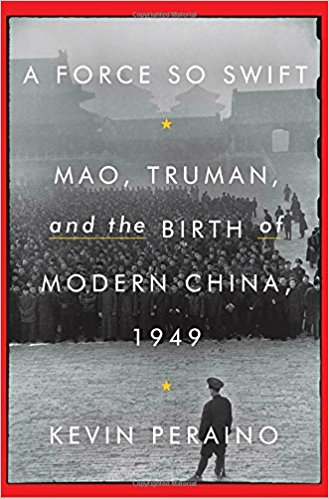
Review: A Force So Swift: Mao, Truman, and the Birth of Modern China (by Kevin Peraino)


 My Rating: 3 stars

I struggled a bit with rating this book, mainly because this book turned out to be very different from what I expected.  I'm quite selective when it comes to non-fiction books, since I know it generally takes more effort on my part to concentrate and focus on what I'm reading due to life's many distractions.   When I see a non-fiction book on a subject that piques my interest, I pick it up hoping that the information will be presented in a way that is engaging and insightful. I'm a bit of a history fanatic and love learning new things, so I tend to gravitate toward books that have a historical element to them.  While this book definitely covered the history aspect well, the part that made it difficult for me to get into was its heavy focus on politics.  I've always viewed politics as a complicated game with constantly-changing rules and a playbook so complex that only those players well-versed in its language have a decent shot at success.  I'm not one of those players and never will be.  I know enough about the basics to help me get through life, but that's about it – most politics go way above my head and to be honest, I'm fine with that, as I have no interest whatsoever trying to understand it.  It's no surprise then that I try to stay away from books that are heavy on politics and this is why Kevin Peraino's A Force So Swift: Mao, Truman, and the Birth of Modern China didn't really work for me.

The book recounts the one year timespan from when Harry Truman starts his second term as President of the U.S. in 1948 to the rise of infamous Communist dictator Mao Zedong and his establishment of the People's Republic of China in October 1949.  Historically, the author covered quite a bit of ground, starting from the end of the Second World War and its effect on the various countries that were involved (specifically the countries that formed the Axis and Allied Powers during the war), running through some of the major events that occurred during that time and the various players involved.  There was also a bit of back history about China, the rise of Generalissimo Chiang Kai Shek and the Soong family, Mao Zedong's early years and his role during the war, the Japanese occupation of China and its aftermath, etc.  – it also touched on some of the cultural differences between China and the U.S. and the basis for these differences from history….this first third or so of the book that dealt with history and culture I absolutely enjoyed.  However, after that, the book started to focus more on the American side of things – more specifically, the intricacies of American politics and development of foreign policy during the Truman administration, details about the political players and strategists who shaped the U.S. policy toward China and the rest of the Pacific, the roles that Europe and also Russia played, etc. – this is where the book started losing me and after I dozed off a few times while reading, I decided to skim my way through the rest of it.

I ended up rating this book 3 stars because it was actually very well-written and well-researched, plus the history and culture parts were really good, it's just that I didn't care for the minutiae with the politics, which unfortunately was majority of the book. For someone like me who is not into politics, I found this book a bit too tedious and way too long (my version came in at a little under 300 pages, with nearly 100 pages of notes/references in the back). Overall, this is a good book that I'm sure those who are into politics will find fascinating and also will learn a lot from it (in fact, our current leader in the big white house (and his staff too) should probably read this book so he understands the history behind our relationship with China and why he can't say the stuff that he has about China and Taiwan the past couple months and not expect to ruffle some feathers – as an added bonus, there's some stuff about North Korea in here too!).

Received advance reader's copy from Crown Publishing via Penguin First to Read program.

Saturday, September 16, 2017

Review: The Glorious Heresies (by Lisa McInerney)


DNF (Did Not Finish) - NO RATING given

Sorry, but this ended up being a DNF for me.  I feel a bit bad about it, as I had actually requested a review copy of this book several months ago and there were some issues with getting the physical book delivered to me -- after all the trouble, I felt like I should at least try to push through the book, despite the subject matter not being something I normally would choose to read.  Unfortunately, it just didn't work out. 

It's actually rare for me to DNF a book and this is actually the first book I've done so in a long time.  I got through a little over 200 pages but couldn't really get into the story -- I didn't like any of the characters, the plot didn't really go anywhere, and even though the writing was good, it was hard to concentrate...I found my attention wavering way too often and I kept setting the book aside.  Or perhaps right now is just the wrong timing for this book.  In any case, this book had won a few awards when it was published last year and scanning through Goodreads it looks like there were some pretty good reviews on it, so I'm sure the book has its merits.  Since I hate not finishing books, I will probably give this another try later on...but since I have other books that I need to get to, I will be moving on for now.

Received review copy from Tim Duggan books (Crown Publishing) via Blogging for Books.

Tuesday, June 27, 2017

Review: On Edge: A Journey Through Anxiety (by Andrea Petersen)


My Rating: 3 stars

Let me start off by saying that this book was definitely not what I expected it would be.  When I first read the book description, I had thought this would be a memoir of sorts, about a woman living with anxiety, how it manifests itself in her life and how she handles it, etc. with some factual information and research included as backup.  While the author did indeed recount her personal journey through anxiety in the book, it unfortunately fell a bit short for me because too much of her story was bogged down by facts and statistics as well as a lot of scientific and technical details that I felt was not all that necessary.  At times, I felt like I was reading a scientific journal rather than a memoir.   Don't get me wrong though – this book was absolutely well-researched and those looking for a more scientific explanation of anxiety interwoven with personal anecdotes and stories will probably appreciate the approach the author took with this book.  For me, I loved the personal stories the author told about her struggle with anxiety and the background with her family as well as the plentiful real-life examples she gave to illustrate particular points – these sections worked well for me and it helped to see how the author came to accept anxiety and learned to live in harmony with it.  I also appreciate the author's tremendous honesty in sharing some of the most intimate details of her life and the role her anxiety played during these moments.  However, on the flip side, there were too many times while reading where I got "lost" in the science, to the point that I felt overwhelmed with too many statistics dancing around in my head.  I've never been a science person, which is why I tend to avoid books that are overly scientific or technical, since I know my brain can't handle it and the information will just pass right through, as it did in this case.  It didn't matter how many times I tried to re-read those sections, nothing was sticking so in the end, I gave up trying. 

I initially chose to read this book because I struggle with anxiety myself and so I was interested in seeing how the author's experience was similar or different to mine.  Subconsciously, I guess I was also looking for some "best practices" of sorts – some insight into how others deal with their anxiety that I could perhaps apply to my own situation.  While I got this partially through the author's personal story, I think I would've been able to connect more with the author's experience if the focus had been more on her story rather than the science and statistics behind it.  

In terms of recommendation, I would suggest reading other reviews before making a determination.   I think for those who don't have a problem with too much science or technical facts, this would be an excellent read, as the author's story truly was interesting and there was much to offer in terms of practical application for others who may be similarly struggling with anxiety.  It didn't quite work out for me, but I would still consider this a good, solid book that I don't regret reading.

Received advance reader's copy from Crown Publishing via NetGalley