Tuesday, February 23, 2021

Review: The Kitchen Front (by Jennifer Ryan)

My Rating: 4 stars

This is author Jennifer Ryan's third novel and while it's only the second one of hers that I've read, I enjoyed it just as much.  One of the things that had really appealed to me back when I read Ryan's debut The Chilbury Ladies' Club a few years back was the way she was able to paint a vivid picture of the home front in England during WWII.  This was a time period where all able-bodied men were expected to enlist and help with the war effort at the front lines, leaving behind mostly women and children (and men who had gotten out of being drafted) to take care of things at home.   With her newest novel, Ryan once again captures the sentiment of the time, through the story of 4 women who join a wartime cooking contest in the hopes of landing a prime spot as co-host of a popular BBC radio program.  Each woman has her own reasons and motivations for joining the contest.  Audrey, a widow whose beloved husband was killed serving his country and now, laden with debt and 3 young sons to take care of, decides that the only way to save the dilapidated house she lives in and therefore keep a roof over her family's head is to win the contest so that she can get a steady, well-paying job.  Gwendoline – Audrey's estranged sister and also the wife of the wealthiest man in the village – enters the contest expecting a sure-fire win that will further cement her status in society, though deep down, she is motivated by a profound lack of self-worth spurred by her violent husband Sir Strickland's disdain and loathing.  Nell is an orphan turned kitchen maid who yearns for freedom from life-long servitude in the Strickland household and sees the contest as an opportunity to finally realize her dreams for a better life.  And finally, Zelda Dupont is a trained chef displaced from London after the hotel she worked at is bombed – having experienced a lifetime of hardship and lost opportunities due to being a woman, she is determined to win the contest so she can return to London at the top of her game and give the men dominating the profession a run for their money.


Through a narrative that alternates between each of the four women's perspectives, we are given keen insight into not just how the war impacts each of their lives, but more importantly, how they persevere and overcome the challenges they're faced with in order to make the best of what they have.  In reading the Author's Note at the end, it was fascinating to learn that parts of the story were actually inspired by real-life events – from the idea of contests (which were popular during that time period due the entertainment it provided and the ability to divert people's minds away from the horrors of the war), to food rationing and the need to pay close attention to ingredients being used, to the actual BBC radio program entitled The Kitchen Front that had been established to share recipes as well as cooking tips and techniques during the war.  I was impressed by the amount of research that went into the story as well as the transportive nature of the writing. Most of all though, I love the food-themed elements incorporated throughout the story, especially the recipes and the resourcefulness of the women who had to find ways to adapt the meals they cooked out of necessity during the war.   Ryan writes in her author's note that many of the recipes she incorporated into the story were from the National Archives as well as from people she interviewed who had lived through those times.  It humbled me to think about how much we take for granted nowadays on food-related matters when back then, it was such a battle just to get food onto the table.  This is one of the aspects I've always loved about historical fiction — its ability to make history more relatable to those of us who never experienced it.


Having read two of Ryan's books, both of which have been inspiring as well as uplifting, I look forward to reading more of her works, including her sophomore novel, published in 2019, that I was not able to get to at the time. If you get the chance to pick up this newest one up, I definitely highly recommend it! 


Received ARC from Ballantine Books via NetGalley


Monday, February 15, 2021

Review: Finding Freedom: A Cook’s Story Remaking a Life from Scratch (by Erin French)

My Rating: 4.5 stars

I'm no food connoisseur, but I love to eat and I also enjoy reading about food, so chef Erin French's new memoir Finding Freedom is technically right up my alley.  French fell in love with food while working the line at her dad's diner as a teenager and later on, as a young adult, maintained a close connection with food through her subsequent gigs as a waitress, bartender,  caterer, and sales clerk at a kitchen supply shop.  Unlike most chefs, French never received any type of formal training – she never went to culinary school and much of what she knows about cooking was self-taught through trial and error in the kitchen (and she has the scars on her arms to prove it) – yet through hard work and perseverance, she was able to turn her passion for food and natural ingredients (from growing up on her parent's farm) into a successful career.  French is the owner of The Lost Kitchen -- a small restaurant tucked into a repurposed 19th century mill  in the little town of Freedom, Maine (population less than 1000).  In the open kitchen of her award-winning restaurant (which is also world-renown), French cooks to a constantly packed crowd, with bookings for the 40-seat dining room usually sold out months in advance.   French's restaurant specializes in  "farm-to-table" cooking where she plans her menus daily around the freshest ingredients she is able to obtain each day – majority of her nearly all-female staff are farmers who tend to their own farms by day and work at the restaurant by night, oftentimes bringing with them to their shifts the ingredients that would be used in the day's dishes (i.e. ripe tomatoes newly picked that morning, eggs laid that day by farm-raised chickens, etc.).


Behind French's success though, is a harrowing personal story of survival – a journey fraught with pain and turmoil, and enough emotional ups-and-downs to last her several lifetimes.  In her memoir, French writes candidly, honestly, and succinctly about her various struggles -- from growing up in a dysfunctional household with an emotionally absent father, an obedient-to-a-fault mother, and an estranged younger sister who loathed her, to getting pregnant at 21, dropping out of college, and subsequently becoming a jobless single mother who eventually moves back in with her parents, then later marrying a man 20 years her senior who turned out to be a scumbag, manipulative monster.  She also lays bare her struggles with depression, suicide, self-loathing, an addiction to prescription drugs that spiraled out of control, and the moment she hit rock bottom after being committed to a psychiatric ward and subsequently forced into rehab, losing everything – her home, her restaurant, her marriage, and most painful of all, her beloved child – in the process.  Broken, beaten, penniless, with all sense of dignity and self-worth shattered beyond repair, it takes all of French's strength – physically, mentally, emotionally – to claw her way back from the precipice and rebuild her life from scratch. 


French's story is poignant and heartbreaking, yet also hopeful and inspiring.  There were moments that made me cry, moments that made me smile, and of course, moments that made me seethe with anger.  French writes with raw honesty and sincerity about her life that is rare and absolutely admirable.  She does not shy away from recounting her own flaws, nor does she deny her own role in making a mess of her life (for example – deliberately ignoring all the red flags and warning signs about her ex-husband Tom and the kind of person he was), which I definitely appreciated.  Prior to reading this book, I actually had never heard of The Lost Kitchen, but afterward, I found myself wanting to learn more about this little restaurant "in the middle of nowhere" and the tenacious woman who overcame the odds and poured her heart and soul into creating it. 


This is a memoir that I'm glad I read and that I absolutely recommend.  Unlike some other food memoirs I've read, I like the fact that this one achieves a good balance between recounting the details of the author's story and describing the various food-related elements such as the dishes that the author cooked and how she sourced her ingredients, etc.  There have been times when I would read a food memoir and the descriptions of the food would consist of various fancy words that usually went way over my head -- French's memoir is different in that it's very down-to-earth and the food descriptions are ones I am able to relate to.  This book actually doesn't come out until April, but if you love food memoirs like I do, I would recommend picking this one up sooner rather than later! 


Received paper ARC from Celadon as part of Early Reader program.


Tuesday, February 9, 2021

Review: We Run the Tides (by Vendela Vida)

My Rating: 4 stars

Vendela Vida's We Run the Tides is a coming-of-age tale set in the 1980s, about two teenagers and their experiences growing up in the privileged, wealthy enclave of Sea Cliff in San Francisco.  Eulabee and Maria Fabiola are best friends who've known each other since Kindergarten – more than that though, they also know every nook and cranny of the oceanside neighborhood they grew up in, even down to the history of each house and its current as well as former occupants.   Now in eighth grade, the two of them attend the elite all-girls school Spragg, where their circle of friends includes two other girls from their neighborhood, Faith and Julia.   One day, as the 4 of them walk to school together, they encounter an "incident" involving a man in a white car that becomes a huge source of contention between Eulabee and Maria, to the point that it ruptures their friendship.  Then later, their relationship suffers further setback when Maria suddenly disappears for a period of time, claiming upon her return to have been kidnapped, which Eulabee finds hard to believe. With their friendship becoming increasingly fraught, can Eulabee and Maria Fabiola overcome the rift that separates them to salvage a once close relationship?


I found this to be an interesting read that captivated me from the first page.  I was invested in the story early on and even though I didn't particularly like the characters (more on this later), I still felt compelled to keep reading because I wanted to find out what happens to the characters and how things pan out for them.  Vendela Vida's portrayal of the mercurial and sometimes confusing relationships between teenagers in the midst of navigating their adolescence was spot on.  The teenage angst, that overwhelming desire to belong, to be accepted and liked, petty grievances that change from one day to another, the self-discovery and gradual realization that all actions have consequences, etc. — so much of this is explored through the lens of Eulabee's coming of age.  


A unique aspect of this story is that it provides a fascinating glimpse into the lives of the rich and privileged, but through the perspective of an adolescent who has known no other way of life.  As a reader, I felt like an outsider looking in, observing a way of life that I can't even begin to relate to. For me, stories revolving around the trials and tribulations of the wealthy elite are a slippery slope, as the attitudes and behaviors of the characters are ones that I usually find difficult to reconcile, which more often than not turns me off to the story.  In this instance though, the story worked, for the most part — despite Eulabee's sporadic bouts of naïveté and ignorance (which, if I'm being honest, did annoy me quite a bit), I still couldn't help feeling a certain amount of sympathy for her at various parts of the story.  


One thing that surprised me was how well-developed the characters came across, especially given the limited insight we get into the characters due to the story being narrated entirely from Eulabee's first person point of view. We see all of the characters — Maria Fabiola, Julia, Faith, all the parents, etc. — through Eulabee's eyes and yet, we still learn quite a bit about the characters, enough to determine how I feel about them.  I thought this was an interesting way to tell the story and appreciate how Vida was able to pull this off given that almost all the characters were largely unlikable (at least to me).


Vida is a "new-to-me" author whose work I wasn't familiar with before but I'm glad to have discovered. I'm definitely interested in exploring her backlist and hopefully get a chance to read another novel of hers at some point.


Received ARC from Ecco via NetGalley.


Saturday, February 6, 2021

Review: Land of Big Numbers (by Te-Ping Chen)

My Rating: 4 stars

With her debut short story collection Land of Big Numbers, Te-Ping Chen brings us an insightful and thought-provoking portrayal of modern day China.  Over the course of 10 diverse and layered stories, Chen provides keen insight into the cultural, political, economic, and social realities of what life is like for citizens in contemporary China and also beyond that, extending to the Chinese diaspora in several instances.  A few of the stories were direct in depicting the plight of Chinese citizens' current reality, while others were more fantastical, employing elements of magical realism to get its point across — all of the stories were well-written though and compelling to read.

While I enjoyed the entire collection overall, a few of the stories were especially engaging, to the point that I couldn't help feeling disappointed when they ended abruptly, without closure.  I prefer fictional stories that are complete — with a beginning, middle, and end — which is why, in general, I'm not particularly keen on short story collections.  I don't like the feeling of being left hanging, though unfortunately, most short story collections do exactly that — this collection, of course, was no exception, though I will say that the quality of the stories does make up for it to some degree.

One of the things I really appreciate about this collection is that it gives readers a glimpse into what life is like for people living in contemporary China.  This is significant given that many of the stories nowadays are about the Chinese immigrant experience in the U.S., which I'm happy to see of course, but I also feel that it's hard to truly understand that experience without having some familiarity with the background history and culture — books like this one are important and necessary contributions to this understanding.

This is a collection that I definitely recommend. At less than 250 pages, the book is brief enough that it can be read in one sitting, yet each story is so deeply nuanced that some amount of reflection is needed before moving on.  As I mentioned earlier, while I did enjoy the entire collection, a few of the stories in particular stood out as favorites.  Among them were:

"Lulu" - about brother/sister twins who grow up in the same household but end up taking radically different paths in life — one becomes a professional gamer while the other becomes a political activist.  I felt this was the most emotionally nuanced story in the collection.

"Hotline Girl" - about a young woman who moves from the village to the city to work at a government call center and also to escape her violent ex-boyfriend, who eventually tracks her down.  

"New Fruit" - about the effects of the qiguo on a village — a 'peculiar fruit' that evokes different, mostly positive, responses from those who eat it, until the day that it suddenly doesn't.  This was an interesting story, one that demonstrated people's propensity toward fickleness but also their capacity for resilience.

"Field Notes on a Marriage" - about an interracial couple where the wife truly begins to understand her husband upon traveling to his home country after his death.  

"Shanghai Murmur" - about the divide between the rich and poor, manifested in a young woman's obsession with an object belonging to one of her customers.

"Gubeikou Spirit" - about a group of people trapped on a subway platform for months, unable to leave until the government gives them permission to do so.  This was by far the strangest story of the entire collection, but also the most fascinating and the one that stood out the most.

Received paper ARC from publisher (Houghton Mifflin Harcourt / Mariner Books).


Monday, February 1, 2021

Review: The Four Winds (by Kristin Hannah)

My Rating:  5 stars


As a fan of Kristin Hannah's work, it should come as no surprise that I went into her newest novel The Four Winds with a high amount of eagerness and anticipation.  Having read and loved several of Hannah's previous novels, the bar was already set high and of course, Hannah did not disappoint – this book was every bit as good as I expected it to be, and then some!


Set in the rural Great Plains in Texas, the story centers around 25-year-old Elsa Wolcott, who longs for a different life other than the sheltered existence she grew up in.  Her parents view her as "unattractive" due to her plain looks and looming height, which also makes her "unmarriageable" and therefore not worthy of their love and attention.  One day when she goes into town, Elsa meets Rafe Martinelli, who finds her beautiful and gives her the affection she has yearned for her entire life.  When Elsa becomes pregnant, her parents disown her and abandon her at the Martinelli's farm, giving Rafe no choice but to own up to his actions and marry her.  Over the next 13 years, Elsa grows into her role as wife and mother, but more than that, she comes to love both the land as well as the people who cultivate it – namely, her in-laws, Tony and Rose, who see the strength and beauty in her that her own parents never did.  In 1934, as years of drought devastates the land and threatens the farmers' livelihoods, the Dust Bowl arrives and further decimates the land.  When the destruction gets to the point where her children's survival is at stake, Elsa must make the difficult decision to either endure and continue to fight for the land she loves or head west to California in hopes of more opportunities and a better life.


This story is not an easy one to read, as it covers one of the darkest periods of the Great Depression where there was a lot of suffering all across the country.  The characters go through hardships both natural and man-made, enduring horrible circumstances so bleak and heartbreaking that it's hard not to admire the indomitable nature of the human spirit and a person's will to survive.  Kristin Hannah always manages to create realistically drawn and memorable characters – flawed characters who mess up and who may not even be entirely likable, yet no matter what, you can't help rooting for them.  For me though, it was more than just rooting for these characters – they ended up endearing themselves to my heart, to the point that I just didn't want to let them go.  I love all the strong, courageous women in this story – from Rose to Elsa to Loreda – all of whom are fictional, yet they felt so real to me.  Hannah states in her Author's note that Elsa and several of the other characters represent the thousands of brave and courageous migrants who headed west back then, bringing with them "nothing more than a will to survive and a hope for a better future."


Hannah is a masterful storyteller at the top of her game, whose beautifully immersive writing style never fails to impress me.  The atmospheric way in which she describes the landscape and the characters' surroundings, along with rich historical details seamlessly woven into the narrative, combine to evoke a strong sense of time and place, which is one of the aspects of Hannah's writing that I love.  I also appreciate the depth of research that went into establishing the historical context for the story – not only did I learn a lot about the Great Depression and the Dust Bowl era, I was also compelled to do additional reading on my own after finishing the book.  


This is my first 5 star read this year and it was definitely well worth the time (though I actually surprised myself by finishing this nearly 500 page book in just 2 sittings).  As I wait (impatiently) for Hannah's next book, I hope I'll have time to continue working through her backlist at some point.


Received ARC from St. Martin's Press via NetGalley 


Monday, January 25, 2021

Review: The Paris Library (by Janet Skeslien Charles)

My Rating: 4 stars

This felt like such a perfect read!  As a book lover, I'm of course drawn to stories about libraries and book stores, but the added bonus with this story is that it also covers one of my favorite genres: historical fiction.  Based on real life people and events, this dual timeline narrative tells the story of the American Library in Paris and the efforts of its staff to keep the library open during the German occupation of France in World War II. The main narrative in the past is told from the perspective of Odile Souchet, the 20-year-old daughter of a police commissioner who gets her dream job working at the Library — she quickly grows close to the staff she meets at the library and together, they join the effort to fight the Nazis the best way they know how: through the power of literature.  In a second timeline interspersed throughout the story, teenager Lily lives in a small town in Montana in the 1980s — lonely and bored, Lily's curiosity is piqued by the elderly woman living next door to her, a widow named Odile Gustafson who mostly keeps to herself, yet has a sophisticated nature about her that stands out in such a small town.  Discovering that they share a lot in common, Lily and Odile strike up a friendship that grows into a special bond as Lily learns more and more about Odile's past and the circumstances that caused her to leave France.

When I first picked this book up, knowing that it would be historical fiction set during WWII, I admit that I was expecting a very different type of story.  Given the subject matter, I thought the story would be bleak and depressing, but while there was certainly sadness, the overall tone was hopeful and uplifting.  Having said that, I definitely preferred the past narrative to the present one, as I loved reading about the library and what went on, plus the characters were wonderfully drawn (it was fascinating to read the Author's Note at the end and find out which characters were actually real people). With the present narrative, the aspect I appreciated most was the special friendship between Odile and Lily, the connection they had, and how we find out towards the end the significance of the two of them entering each other's lives at the times they did.

This is a book that I would definitely recommend, as it is absorbing, engaging, and absolutely atmospheric — a lovely story from an angle that doesn't get covered much in the canon of WWII fiction.  I appreciate how the author didn't gloss over the serious stuff — the grueling history of that time period and some of the atrocities that took place — but at the same time, didn't take a heavy-handed approach either.  It's not often that I feel compelled to do additional research after reading a book, but this one definitely did — I was so fascinated by the story that I wanted to read more about the Library and the real-life people who had made things happen.  To me, that's as sure an indication as any as to how much I liked this book!  In addition to looking forward to this author's next book, I also hope to check out her acclaimed debut at some point!

Received ARC from Atria Books via NetGalley

Sunday, January 17, 2021

Review: Waiting for the Night Song (by Julie Carrick Dalton)

My Rating: 4 stars

This was another one of those books that I found difficult to fit neatly into a single genre.
  While the timeline was a bit ambiguous (the chapters alternated between "that summer" and "present day"), there was a strong contemporary fiction vibe with many of the issues explored in the "present day" narrative -- climate change, illegal immigration, racism, politics vs science, etc. – mirroring so closely with so many "hot-button" issues that we as a society are dealing with currently (and have been at the forefront of discussions the past few years).  Having said that, there was also a mystery / thriller component to the story that overlapped both timelines, with "the truth" about the defining event that occurred in the past eventually being revealed in the present.   

From a genre perspective, I felt that the contemporary piece was quite solid overall, which I guess shouldn't be too surprising given the author Julie Carrick Dalton's background as a journalist.  This was definitely apparent in the extensive detail with which Dalton was able to present the events around the climate crisis as well as the complexities of the immigration discussion.  In all honesty, I personally have not paid much attention to the climate change discussion, I'm not a "science-y" person and a lot of the explanations out there about the topic seem to go over my head — but the way Dalton presented the topic, through the fictional story of Cadie (who later grows up to be an entomologist) and her best friend Daniela, the childhood adventures they have in the forests surrounding their properties, the challenges that arise nearly 30 years later, etc., helped provide some clarity about the climate crisis that I had a struggled to understand reading about the topic via other means.  Of course, there's a lot I still don't understand about the topic (and probably never will), but the fact that I was able to comprehend as much as I did speaks to the power of fictional story-telling in helping us understand real-life events and situations.

With all that said, what didn't work as well was the mystery / thriller aspect of the story.  I felt that the attempt to craft a compelling thriller was a bit weak, as the plot points were predictable and too easy to figure out.  In fact, I actually was able to guess "the truth" quite early on, so when it came time for the big reveal, the surprise element was no longer there.  Also, some of the events meant to "explain" the mystery felt a bit forced — as I was reading, it became obvious to me that the strongest parts of the story were those not having to do with the "mystery" thread.  

Overall, this was a good story with well-drawn characters. I especially appreciated how the author explored modern day issues in a way that was both respectful and approachable.  Of course, no story is perfect and as much as I liked the approach the author took, I also felt that, at times, the various "big topics" covered here were competing with each other for space — especially in the "present day" timeline, the writing was a bit uneven in that there would be large sections about the climate issue, about science and politics, but those parts felt randomly inserted and separate from the other threads.  This did affect the flow a little in my opinion, but not to the point of negatively impacting the story.  

I'm glad I read this one, as the story was a timely one and I learned things I wasn't expecting.  As this was Dalton's debut, I look forward to seeing what she brings to the table next.

Received print ARC from Forge Books


Monday, January 11, 2021

Review: Faye, Faraway (by Helen Fisher)

My Rating: 2.5 stars

I don't read much science fiction, as the genre just doesn't interest me and I don't want to waste my time slogging through books that I know I most likely won't enjoy.  Having said that though, I AM open to occasionally trying out books of other genres with sci-fi themes worked into the story (as long as it's not hard-core sci-fi stuff) and there have been plenty of times where I actually had a good reading experience.  This is one of the reasons why I decided to pick up Helen Fisher's debut novel Faye, Faraway – with its premise as a "heartfelt" story about family, relationships, love, and time travel, I thought it would be one of the "exceptions" that I would be able to appreciate.  The summary describes this as an emotionally gripping, contemporary story about a woman named Faye who time travels back to the past to see her mother, who had died 30 years ago when Faye was just 8 years old.  Faye becomes friends with her mother (who doesn't know who she is of course) and the more time she spends with her, the more Faye doesn't want to let her go, even though she knows she must do so in order to return to her beloved husband and 2 daughters.  In the end, faced with an impossible scenario, Faye must choose between a second chance to make things right with her mother in the past or letting go and returning to her happy life with her family in the present.  Based on this premise, I went into this one expecting to be moved and perhaps to even shed a tear or two – but my reaction ended up being the opposite.  Instead of the expected emotional reaction, I ended up feeling super annoyed and frustrated, both with how the story played out, as well as with the characters. 


The story is narrated from Faye's first-person perspective, which I feel like is one of the things that didn't work too well in this instance, as it seemed that Faye spent way too much time explaining and justifying (and re-explaining and re-justifying) practically every action she takes, especially as it pertains to her time travel.  Normally this wouldn't be a problem, but I found most of her arguments irrational and nonsensical.  I'm all for flawed characters in stories (as we are only humans after all and are bound to make mistakes and bad decisions), but I also need to see these characters grow in some way as the story progresses, rather than remain one-dimensional from beginning to end.  With Faye, I felt like she didn't change throughout the story – her behavior was childish and immature from the start and it continued to be up until the very end.  I also got annoyed by the fact that Faye would act overly unreasonable and stubborn throughout nearly the entire story – even when others tried to reason with her, she didn't seem to want to listen.  Maybe I'm being too harsh, but I just find it hard to believe that Faye's overwhelming desire to see her dead mother again (even she herself called it an "obsession") could be all-consuming to the point that she was willing to put the life and happiness that she spent over 30 years building,  (not to mention her family's happiness) in jeopardy.  The first time Faye encountered this dilemma (going back versus remaining in the present), I  could understand her struggle with it and even empathize with her, but after repeated conversations with people who would tell her over and over again the dangers of her actions and how it wasn't worth the risks, and even after she acknowledged they were right, but most importantly, she recognized that it was unfair to put her husband and daughters through the ordeal of potentially losing her if she got stuck in the past and couldn't return, she still insisted on going, as she missed her mom too much not to do so.   It was unfathomable to me how she could be so irrational and irresponsible, especially given how much she claimed that she couldn't bear to leave her family.


The other part of this whole thing that annoyed me was the fact that Faye felt like she couldn't tell her husband Eddie the truth (about her time traveling) because she knew he would try to stop her (especially since each time she traveled back in time, she would get physically injured) and she wouldn't be able to bear it – so she decides to lie to him, even though she knows full well her husband can see right through her (as she repeats this continuously throughout the story).  Then, when it gets to the point that her husband can't stand it anymore and thinks she's having an affair, she becomes indignant and belligerent, almost as though she is outraged that her husband would think such thoughts – again, her reaction made no sense given that she was the one evading his questions and telling him lies that even she herself didn't find plausible.  And then later, Faye berates the one friend who believed in her — when he tried to persuade her not to take the risk of going back to the past again due to the dangers and what it would do to her family, she insults him and claims that he's jealous and throws his disability (blindness) at him...she even tells herself she knows she's being unfair and he's only trying to help her, but she's so mad at her own helplessness that she lashes out at anyone who tries to "walk her down from the ledge."  Basically, my experience with this book was that each scene as the story progressed got more and more ridiculous, with Faye's behavior more and more reckless and hysterical – needless to say, the more I read, the more frustrated I became.  


One of my biggest pet peeves when it comes to characters in books are immature adults who behave unnecessarily defiantly – meaning they know that certain behaviors and/or actions are not constructive and, upon taking the time to weigh the risks, they understand that the outcome would be more harm than good, yet they proceed with the bad decision anyway, all the while telling themselves the equivalent of "I know I shouldn't but I'm going to do it anyway" (and then of course regret it later when things don't go as planned).  Characters like these frustrate me to no end, especially when their actions and behavior make them come across as stereotypical (which Faye certainly did in this story, at least to me).  Unfortunately, in this instance, it wasn't just the characters, as parts of the plot didn't make sense either, plus certain sections were bogged down by wordiness, with explanations and excessive descriptions of things that didn't seem to have anything to do with advancing the narrative. 


Overall, I struggled with this one and while I wouldn't say it was a complete lost cause (I did finish the book after all), I felt that much of the story was a stretch and there really didn't seem to be a point to it.  If I had to sum this one up, I would say that it's basically Faye on infinite loop trying to justify her time traveling with back-and-forth arguments that honestly didn't warrant 300 pages to get across.  I also didn't feel the emotional pull that others seemed to experience with this book, though this was likely due to my annoyance with the main character being so strong that it was hard to feel anything else for her or any of the other characters.  It could also be this was just the wrong book at the wrong time for me given the events of this past week and being inundated with examples of people showing poor judgment and making bad decisions.  As I'm an outlier on this one amongst the many 4 and 5 star reviews, I would definitely recommend checking out those reviews as well for a more balanced perspective.


Received ARC from Gallery Books via NetGalley.


Monday, January 4, 2021

Review: Meet Me in Bombay (by Jenny Ashcroft)

My Rating: 4 stars


As my first official read of the new year, Jenny Ashcroft's Meet Me in Bombay is a book that I found difficult to put down as soon as I started reading it.  When I first read the book's summary and saw that the premise would be a love story set in Bombay, against the backdrop of the Great War, I admit that I was a little apprehensive, as I'm not usually one to gravitate toward love stories for one, and two, I wasn't sure what to expect with Ashcroft being a "new-to-me" author whose previous works I've never read. Also, while I'm a fan of historical fiction, I'm not too keen on historical romances, which I knew this one would be going into it.  In the end though, the setting of pre-WWI Bombay won me over, mainly because there are so few historical fiction novels nowadays that are set in this time period, so to come across one, even if it's a romance, I felt it would still be worth my time.  I'm glad I went with this one, as it turned out to be a good story, well told (even though there were definitely moments where I felt frustrated with parts of the story).


The story revolves around Madeline ("Maddy") Bright, the daughter of a British diplomat stationed in Bombay, India during the early 1900s.  Having spent most of her childhood and adult life in England, Maddy returns to the place of her birth thinking it will only be a temporary visit to see her parents – however, due to unforeseen circumstances back home, she ends up remaining in Bombay indefinitely.  At a New Year's Eve party in 1913, she meets charismatic Luke Devereaux and over the course of the next few months, they fall deeply in love. As Maddy and Luke are on the brink of planning for a happy future together, World War I erupts and as Luke is in the reserves, he has no choice but to join the ranks and fight in the war.  Forcibly separated due to circumstances beyond their control, Maddy is consoled by Luke's promise to return to her after the war – a promise that becomes difficult to keep after Luke emerges from the war broken and unable to remember the woman he once loved.


Based on the summary, I initially went into this one thinking the story would be predictable, but was pleasantly surprised that the author ended up taking an entirely different direction than I anticipated.  Right off the bat, the structure of the story was already unique, as it started off with snippets of what sounds like a letter from a soldier to his lost love, and then from there, the narrative goes back and forth in time, slowly revealing bits and pieces of a story that we don't get a full picture of until the very last pages. It was an interesting structure and I came away with a sense of awe at how the story turned out (with my immediate reaction being to go back through some of the previous sections in the later timeline to validate the way the threads came together). 


In terms of the writing, Ashcroft's style here was very descriptive, and like most good historical fiction, atmospheric to the point that I felt transported to the time and place and circumstances that the characters were experiencing.  With that said though, some parts were a bit too descriptive and unnecessarily drawn out, but fortunately it didn't detract too much from the overall story (at least it didn't to me).   I found this to be an immersive read – so much so that I ended up finishing it in two sittings without even realizing it.  My one complaint though, as I alluded to earlier, was that some parts of the story frustrated me, especially as it pertained to a few of the characters (i.e. Maddy and her mother Alice) and the (at times) seemingly intentional lack of communication between some of them which resulted in things happening that I felt were preventable.  I saw these instances as "melodrama for melodrama's sake," which never fail to annoy me whenever they occur in any story (not just this one).  Luckily, these moments were few enough that it didn't negatively impact the story in a huge way.


So far, it looks like my 2021 reading life is getting off to a good start.  While there's no way for me to anticipate how this new year will turn out, one thing I can always rely on is that I will encounter at least a few (hopefully way more) good books that enhance my reading experience.  I'm excited and definitely looking forward to it!


Received ARC from St. Martin's Press via NetGalley.


Saturday, January 2, 2021

2020 Year In Review

Happy New Year!

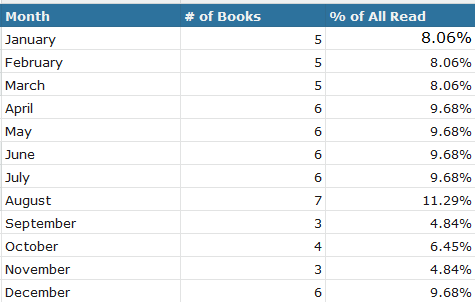
As I sit down to write this recap and reflect upon what type of year this has been, I can’t help but agree with everyone who has used words such as “challenging” or “unprecedented” or “difficult” to describe 2020.   While everyone copes with difficult situations in a myriad of different ways, my “go-to” method in times of stress has always been to escape my worries by seeking solace in books and reading.  So as I look back at my reading life in 2020, it is definitely not a surprise to me that I have read more books this past year than I have any other year to date.  Though technically speaking, my total number of books read this past year, on average, is not too huge of a difference from past years (that number usually hovers between 55 to 60 books), I feel like I’ve gotten more out of my reading in 2020 than I have compared to other years.  While there were definitely months where it was difficult to focus given everything else that was going on in the world, one thing I noticed about my reading life this past year is that it was a lot more “reflective” than years past -- meaning that I seemed to gravitate more toward books that were either “comfort reads” for me in genres that I love, or that added to my understanding and helped me make (some) sense of the complicated world I’m currently living in.    

For 2021, one of the things I would like to do is go back to trying out genres that I don’t normally read (i.e. sci-fi and fantasy) – which I’ve done the past couple years but didn’t in 2020 because of the reasons mentioned above.  As I’ve mentioned before, I’ve always been a huge advocate of reading widely and diversely -- while I still found ways to diversify my reading last year, genre-wise I pretty much stuck to the “tried and true” ones where I knew it would be more likely for me to have a positive reading experience.  

In addition to the above, another big goal for 2021 in terms of my reading life is to read more of the books I own or that are on either my physical or electronic bookshelves.  I bought a lot of books last year (in both e-book and print format), many of which I have not had the chance to read.  Of course, I will still be requesting and reading ARCs of new releases like I usually do (I don’t see myself ever being able to get away from that), but I hope to manage it better this year in terms of balancing ARCs of new releases with backlist books that I already own.

So without further ado, here’s my recap, starting with stats from my 2020 reading log: 


Favorite Reads of 2020

Below is my list of favorite reads this year (in no particular order) – all of these books I rated 5 stars:        

I’d Give Anything by Marisa de los Santo


The Color of Air by Gail Tsukiyama


Musical Chairs by Amy Poeppel


The Exiles by Christina Baker Kline


Anxious People by Fredrik Backman


Before the Ever After by Jacqueline Woodson


Stories from Suffragette City (short story collection edited by M.J. Rose and Fiona Davis)


The Vanishing Half by Brit Bennett


The Poet X by Elizabeth Acevedo


The following books I rated 4.5 stars, which for me means that they were all excellent books in their own right, it’s just that they didn’t give me the 5 star “vibe” due to a minor flaw or two:

Long Bright River by Liz Moore


These Women by Ivy Pochoda


The Last Train to Key West by Chanel Cleeton


Eat a Peach by David Chang


Silver Sparrow by Tayari Jones


Fifty Words for Rain by Asha Lemmie


The following books I rated 4 stars but they were particularly enjoyable reads for me so I figured I would mention them as well (again, in no particular order):

Big Lies in a Small Town by Diane Chamberlain


Interior Chinatown by Charles Yu


All the Ways We Said Goodbye by Beatriz Williams, Lauren Willig, and Karen White


Hollywood Park: A Memoir by Mikel Jollett


Resistance Women by Jennifer Chiaverini


You Are Not Alone by Greer Hendricks and Sarah Pekkanen


Deceit and Other Possibilities by Vanessa Hua


Days of Distraction by Alexandra Chang


Daughter of the Reich by Louise Fein


Redhead by the Side of the Road by Anne Tyler


Lovely War by Julie Berry


28 Summers by Elin Hilderbrand


The Second Home by Christina Clancy


His & Hers by Alice Feeney


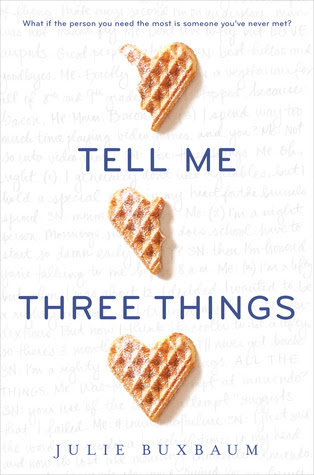
Tell Me Three Things by Julie Buxbaum


The Jane Austen Society by Natalie Jenner


The Night Swim by Megan Goldin


Dear Emmie Blue by Lia Louis


Don’t Look For Me by Wendy Walker


A Single Swallow by Zhang Ling


White Ivy by Susie Yang


Relish:  My Life in the Kitchen by Lucy Knisley


You Have a Match by Emma Lord