Monday, September 19, 2022

Review: Lucy by the Sea (by Elizabeth Strout)

My Rating:  5 stars

This was a pandemic novel I didn't know I needed!  With Elizabeth Strout being one of my favorite authors, I will pretty much read anything she writes — so of course I was ecstatic to have been approved for an early copy of her latest novel, Lucy by the Sea,which brings back one of my all time favorite Strout characters, Lucy Barton.  This time around, it is the very early stages of the COVID pandemic and Lucy is whisked away to Maine by her ex-husband William, who, as a scientist, knows a thing or two about the situation going on with the virus.  Lucy agrees to go with him to the isolated house by the sea for what they both think will be "only a few weeks" (one of my favorite scenes was early on in the book when Lucy is in her apartment packing her things and trying to decide what to bring for what she anticipates will be a short stay in Maine — the laptop scene was classic "Lucy and William bantering over the most mundane things" and I loved the familiarity of it!).  As the weeks turn into months, the situation escalates, with Lucy and William eventually going into pandemic lockdown as things around the world become more and more dire. 

Just like with the previous Lucy books, we as readers essentially live inside Lucy's head the entire story as she narrates her day-to-day experiences (whether good or bad), observations, and feelings toward everything that happens.  As Strout does brilliantly with each of her novels, she provides keen insights into the human condition through her characters' astute observations and empathetic, heartfelt emotions that reflect the realities of our everyday lives.  One difference this time though, is that many of Lucy's experiences and sentiments hit extremely close to home, given the timeframe spanning recent events such as the pandemic lockdown, the George Floyd murder and subsequent protests, the January 6th insurrection, etc. — resulting in shared feelings of anxiety, fear, unease, and a sense of feeling unmoored in a country becoming more and more divided. 

I read Oh William! last year and while I did enjoy that one, I felt that focus was more on William's story rather than Lucy herself, and in that sense, it felt a little less relatable than the first book My Name is Lucy Barton did.  This new book, Lucy by the Sea, brought the focus back to Lucy, which I definitely appreciated, as it gave me the same poignant, relatable vibe that the original one did, which made me love this one just as much.

Fans of the Lucy Barton series will no doubt love this newest sequel, though it's definitely recommended to read the previous books before this one (except Anything is Possible, which is part of the series but doesn't focus as much on Lucy herself — I still need to read this one myself).  Also, Elizabeth Strout fans who have read her other books will love the Easter eggs scattered throughout the story, especially the appearances by other characters who featured prominently in some of her other works.  This added a "fun" element to the story that helped to balance out some of the "heaviness" of the subject matter for me. While I'm not sure if there will be another Lucy book after this one, I will absolutely read whatever else Strout comes out with in the future!

Received ARC from Random House via NetGalley.

Saturday, September 10, 2022

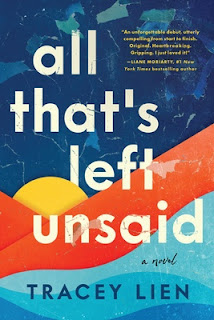
Review: All That’s Left Unsaid (by Tracey Lien)


My Rating:  5 stars

When I first read the premise for Tracey Lien's debut All That's Left Unsaid, I knew this was a book I wanted to read.  Comparisons to some of my favorite authors (Liz Moore, Celeste Ng, Brit Bennett) aside, I was intrigued by the case at the center of the story:  17-year-old Denny Tran attends a dinner at a local restaurant in Cabramatta, Australia (a suburb in Sydney) with his friends, but before the night is over, he is brutally murdered in plain sight of over a dozen witnesses, yet all of them claim not to have seen a thing.  The Tran family is devastated, but faced with an indifferent police force in a refugee enclave where the proliferation of drugs (specifically heroin) as well as violent crime have become commonplace, Denny's parents seem to have no other recourse but to accept the "bad luck" of their beloved son's murder.  But Denny's sister Ky refuses to let things simply get swept under the rug.  Desperate to assuage her feelings of guilt for leaving the family in order to pursue her own life in Melbourne (an act akin to "abandoning" the family and is severely frowned upon in traditional Asian households), Ky returns to Cabramatta and, after her brother's funeral, decides to seek out and interrogate each of the witnesses herself in order to find out the circumstances behind Denny's murder.  With each person she speaks to, Ky gets closer to understanding what happened to her brother, but at the same time, she discovers the myriad complexities and difficulties of navigating the path to justice and closure for her family in a community where its citizens are mostly resigned to their fates.

There was honestly so much to unpack with this story that it is impossible to cover every angle in a brief review such as this one (personally, I highlighted so many things in this book that were significant to me, it would take me pages and pages to parse all of it).  I will attempt to relay a few thoughts that stood out, but I encourage people to actually read this book in order to get the full experience.  

I do want to start off by saying that this book is technically incorrectly classified under mystery / thriller.  While it's true that the plot overall revolves around unraveling the "mysterious" circumstances behind Denny Tran's murder, it quickly becomes obvious (a chapter or so into the story, in fact) that his death is actually the trigger point for a deeply complicated and intricate exploration of community, society, class struggle, immigration, culture and assimilation, systemic racism, family bonds, parent-child relationships, generational trauma, mental illness, abuse, etc (and that's just scratching the surface).  The "mystery" itself was easy to figure out, which essentially rendered the ending anti-climactic, but the gut wrenching process of getting to that point was really the crux of what made this story work so well.  With its "social commentary" angle, I feel like this would've fit more appropriately into literary fiction, though from a time and place perspective — Cabramatta (which was an actual place in Australia) in the 1990s, during which time there truly was a heroin epidemic — there was also a historical element to the story as well that I didn't expect, but made the story even more compelling.

Before I go into talking about the characters, I wanted to comment on the title and structure. This book actually has one of the cleverest titles I've ever seen: it complements the book perfectly because when we peel back the layers, the story is essentially about "the many things that are left unsaid" by every character in the book — not just the witnesses from that night, but also the parents, Denny, and even Ky herself.  So in this sense, there is a deeper meaning to the title that can only be understood after reading and reflecting on the entire story.  Structure-wise, I love how the narrative alternated between various perspectives — sure, we got Ky's perspective primarily, but there were also chapters narrated from the perspectives of the witnesses as well as Ky's parents.  Through these chapters, we were able to get the backstories to the various characters, which helped us understand what ultimately drove each character's decision that fateful night.  Structuring the narrative this way not only made the story more powerful and poignant, it also helped make the characters realistic and relatable, which I felt was very important to this story overall.

Speaking of the characters, I truly appreciate the brilliant job that the author Tracey Lien did in the area of character development, especially with Ky and Minnie.  Reading this book was actually quite an emotional roller coaster for me because of the resonance I felt with the characters and so much of what they went through.  With Ky especially, I saw so much of myself in her — from her struggles with  identity and acceptance, to her analysis of her own shortcomings and insecurities, her feelings of anxiety related to the environment in which she grew up, and most significantly, her relationship with her mother.   I've always been drawn to stories about parent/child relationships, but those between Asian mothers and their daughters are especially resonant with me because of my cultural background and the hope that reading about these relationships will help me navigate the complex dynamic that exists there.

One of the other things I loved about this book was how, through the character of Ky (and Minnie to some extent), Lien so accurately expressed the realities of life for many Asian women like myself — daughters of immigrants (and/or refugees) who may or may not have been born in the Western countries where we grew up and currently live — and how many of the conflicts that we constantly deal with, be it the cultural expectations or the societal pressures that come with being Asian and female, greatly inform how we end up interacting with our parents (and with others as well).  I wanted to share the below passage from the book, which blew me away when I read it because it hit the nail on the head and made me feel "seen" in a way that so few books I've read in the past have been able to do.

"To anyone else, [his] reason would have been baffling. But Ky understood. She hated how well she now understood. After all, hadn't she kept every hurt she'd ever experienced from her own parents? Hadn't she hidden the bullying, the name-calling, the cruel acts of strangers, the times she'd been told to go back to where she came from, the ching-chongs, the pulled-back eyelids, the blondies with the Cabbage Patch Kids, the way she was forced to play the monster, the way she was asked why she couldn't just take a joke, the times she was told that Asian women were ugly, kinky, docile, crazy, nerdy, unworthy, the way she was dismissed by men, the way she was dismissed by white men, their comments about what Asian women were and weren't, what Asian women could or couldn't be, the way she smiled with her tongue pressed against her teeth even as an ache beat in tandem with her heart—hadn't she hidden all of that? And hadn't she lived her own ambitious, exciting, anxious, uncompromising life while knowing that she could never, ever, ever, ever tell her parents about what she had been through? Because knowing would break their hearts. Because she had to help them believe that their sacrifices had paid off. Because she had to help them believe that moving to a country where they didn't speak the language and weren't seen as individuals had been worth it. Because she had to convince them that they'd done right by their children, that no one had failed, that no one had been let down, that they were one of the lucky ones who'd followed the path and found success. It made perfect sense. You lied to protect. You lied because of love."

This is a book I definitely recommend and will likely want to re-read myself at some point. However, with that said, a word of warning that this is not going to be an easy read  — it is sad and heart wrenching, it presents truths about our society that may be difficult to face, and it may take you places that you would rather not be, especially with some of the things going on in the world at the moment.  But is is a worthwhile read — I would even say that it's a necessary read — for those who are up to it, of course.  This was a fantastic debut and I definitely look forward to what Tracey Lien has in store for us next.

Received ARC from William Morrow via NetGalley.

Monday, September 5, 2022

Review: The Ways We Hide (by Kristina McMorris)

My Rating: 4 stars

I have most of Kristina McMorris's works on my TBR, though so far, I've only had a chance to read two of her books — this book, her newest novel The Ways We Hide, and her previous one, Sold on a Monday, which came out back in 2018. While I have every intention of getting through McMorris's backlist at some point, I also don't want to miss any of her new works — which is why, as soon as I saw that she had a new book coming out this month, I requested an ARC before even reading the summary of what the book would be about.  After I got approved, I went back and read the blurb, which made me even more intrigued and excited to read the novel.  While I've read plenty of books set during World War II and covering various themes, one that I haven't come across is exactly what McMorris's new book explores:  the role of magicians / illusionists in the war effort.  Up until this point, I've always thought about magicians as entertainers, never realizing that there were very practical ways they could put their skills to use during the war, such as helping to design escape plans and contraptions or other gadgets that could hide things such as maps. This was a fascinating concept to me and an angle not often explored in WWII-themed fiction.  Not only that though, in terms of this particular story, the illusionist is a woman (the main character Fenna Vos), which is even more rare given the time period and the prevalent society conventions at the time.  

From a historical perspective, McMorris did a great job relaying the various elements related to real-life events and people, as well as establishing an atmospheric sense of time and place. I remember reading somewhere that McMorris mentioned this is one of her more ambitious novels to date, which I can totally see, as this one actually covered quite a bit of ground, with a time period spanning 1928 to 1945, a setting across three different countries (United States, England, the Netherlands), and a multitude of historical events / people covered (which I didn't actually realize until I read her Author's Note at the end of the book).  The meticulous research she did in preparation was obvious in the way she was able to utilize so much descriptive detail throughout the story, whether in reference to historical events and people, or even the gadgets created for military use.  Also, with Fenna's background as the daughter of Dutch immigrants and so parts of the story revolves around the Dutch community she grows up in, I ended up learning a lot in that area as well.

In addition to the story being well-written, the characters were also well-drawn, with Fenna written in a way where, as readers, we can't help rooting for her through all the hardships.  With that said however, I honestly found it difficult to connect with her on an emotional level — which is strange given the entire story was told from Fenna's first person point of view, so we are privy to all her inner thoughts and feelings.  I think part of the reason for this is because, for me, some parts of the story ended up focusing a bit too much on Fenna's romantic relationship with Arie, to the point that it drove a large part of Fenna's actions and decisions during a certain portion of the story.  Normally this wouldn't be a problem, but given the premise of the story and the highly dangerous situations she often found herself in, some of her actions came across as irrational and illogical.  While the romance piece wasn't overwhelming compared to the rest of the story, it was a little distracting for me because I was expecting more focus on the historical piece and how Fenna uses her skills as an illusionist and escape artist in her work with MI9.  This was also the main reason I ended up rating this 4 stars instead of 5, as I felt like the direction of the story strayed a bit near the midway mark and also, the emotional connection was lacking.

Overall, I definitely liked this one quite a bit and recommend it as a worthwhile read, especially for the different and refreshing angle it presents in terms of WWII historical fiction.  

Received e-ARC from Sourcebooks Landmark via NetGalley and print ARC via BookBrowse First Impressions program.

Tuesday, August 30, 2022

Review: The Cartographers (by Peng Shepherd)

My Rating:  4 stars

Peng Shepherd's The Cartographers is one of those books that surprised me in ways that I wasn't expecting.  I will admit that I probably would not have picked this one up if it had not been chosen as a book club read — mostly because I have little to no interest in maps (or anything related to it), plus I'm not really into books with magical realism because I don't really understand it, which means I will likely struggle through it and risk detracting from the reading experience.  With this book however, as soon as I started reading, I was instantly absorbed and quite honestly did not even think about the magical realism aspect until I got to those specific sections — and even then, the scenes didn't go completely over my head like I thought it would.  Basically, those scenes made logical sense to me in the context of what was happening in the story up to that point.  The premise itself was quite unique, the story overall was well-written, the plot moved along at a relatively fast pace, and the characters were well-drawn. 

This book captivated me, probably because I've never read anything like it.  I mean, I've read "genre mashup" books before, but this one was done in a way that felt so different, especially thematically.  There were elements of fantasy and magical realism (as already mentioned), but there were also mystery and intrigue, thriller-seque suspense, history and geography, contemporary realism, and even a dark academia and gothic vibe at certain parts. They're was also a literary bent to this with the setting of the New York Public Library, where much of the action takes place.  All of this came together in a mesmerizing, gripping story that I thoroughly enjoyed, even though this kind of book normally wouldn't really be up my alley.

If my review sounds a bit vague, it's definitely intentional, as this is the type of book where knowing next to nothing makes for the best reading experience.  Having said that, this one wasn't perfect by any means — I was actually able to figure out the ending as well as the various correlations between past and present quite easily, and yes, there were moments where I had to suspend disbelief a bit, but I was fine with that, since I knew going in that there would be some magical / fantastical elements to the story, so I was prepared.

I definitely recommend this one, especially if you're a fan of stories with magical realism.  This also made me curious about Peng Shepherd's other works as well.  Looks like I will need to check out her backlist at some point!

Tuesday, August 23, 2022

Review: Tomorrow in Shanghai (by May-lee Chai)

My Rating:  3.5 stars

While I liked this short story collection overall, the problem I had with it was similar to what I usually experience with short stories — the way the stories begin in the middle of an event and then break off suddenly, created a feeling of "incompleteness"  that honestly made it difficult for me to truly enjoy this collection the way I would a complete story or novel.  When I read a story, I'm pretty big on character development — which, for me, means being able to follow a character (or characters) through their journey and watching them grow and evolve in the process.  Unfortunately, most short story collections naturally lack in this area due to the short amount of time the reader gets to spend with the characters.  Oftentimes, as soon as I start to warm to a character, the story is over - the abruptness of it makes me feel like I've been left hanging and that I'm perhaps missing something. It's a feeling I never enjoy having, which is why short story collections are oftentimes a hit or miss for me (the ones where the same characters "show up" throughout the collection or where there is some sort of connection between all the stories usually work better for me).

With this latest collection from May-lee Chai, one of the things I really liked was the variety of the stories in terms of type and genre — there were ones that explored modern day issues realistically while others veered more into the science fiction and fantasy realm.  Having said that though, this became a detriment when it came to the stories that felt inadequately short, as it felt particularly jarring when I was suddenly being plucked out of one world and dropped into an entirely different one.  This was made all the more frustrating when it would happen each time the story started to get interesting (or, as mentioned earlier, when I was starting to warm to a character and wanted to read more about them).  By the time I got to the end of the collection, I felt dissatisfied and (I hate to say it) also a bit cheated.  

Overall, I felt like this collection had potential, and based on the premise of this being about the global Chinese diaspora, I was actually quite looking forward to reading it.  The content of the stories were good, but the overall feel was too choppy, causing this collection to fall a bit short in the end.  I think if Chai were to take these short stories and expand them to be more complete (like perhaps turn them into novellas?), that would've worked better, at least for me (I would definitely read them if that were the case).

Received ARC from Blair Books via Edelweiss.

Sunday, August 21, 2022

Review: A Map for the Missing (by Belinda Huijuan Tang)

My Rating:  4.5 stars

Belinda Huijuan Tang's debut novel A Map for the Missing is a moving story about family, forgiveness, identity, loss, and the weight of cultural expectations versus personal ambition.  

When we first meet Tang Yitian in 1993, he is a mathematics professor at an American university in California, where he has lived with his wife Mali for nearly a decade.  One day, he receives a phone call from his mother, who still lives in their ancestral family village in China, informing him that his father has mysteriously disappeared. Yitian is estranged from his father and as a result, he has not set foot in the village in 15 years — yet Yitian agrees to return to his child home home to help look for him.  When he arrives in China however, he feels like a fish out of water and has no choice but to seek out the help of his childhood friend (and his first love), Tian Hanwen, who is now a housewife to a mid-level bureaucrat. Together, they begin the search for Yitian's father, but along the way, they end up discovering truths about themselves and their families that change long-held perspectives about their lives.  Through a narrative that switches back and forth between the 1970s and 1990s, we eventually learn the characters' backstories and the link between their pasts that impact their lives in present day.

It's been awhile since I've come across a book that resonated with me on so many levels. Throughout the story, both Yitian and Hanwen struggle between pursuing their dreams and forging their own path in life versus following cultural expectations of filial piety that require them to fulfill their obligations to their families. This is a struggle that I'm intimately familiar with, which is why reading this book was quite an emotional experience for me.  Reading about Yitian's feelings of inadequacy in not being able to reconcile his ambitions and the trajectory of his life with his responsibilities toward his parents (regardless of how they treated him), I found myself nodding along in understanding and sympathy.  I was also able to relate to his experience returning to his hometown after so many years away, and the unexpected culture shock that made it difficult for him to navigate a world that used to be familiar to him.  This was actually one area that I felt the author did an especially great job with:  conveying the unending struggle that immigrants like us have with reconciling the meaning of "home" and feeling like a "perpetual foreigner" in both worlds.  

There's actually quite a bit to unpack with this novel — the themes of loss and forgiveness, reconciling past and present lives with future, social mores versus personal values, the price of ambition and trying to forge a better life for oneself versus the obligations of family and cultural inheritance — it's impossible to cover all aspects in such a short review.  With that said, I appreciate Tang's realistic yet deeply nuanced portrayal that quite honestly continues to give me much food for thought even now, several days after having finished the book.  

This was an absolutely worthwhile read — one I definitely recommend.  Of course, given the cultural elements, the experience reading this will probably be different for each person, but with the variety of themes it covers, I don't think it will be difficult to find something relatable in the story.

Received ARC from Penguin Press via NetGalley.  

Monday, August 15, 2022

Review: Carrie Soto is Back (by Taylor Jenkins Reid)

My Rating: 4 stars

The first Taylor Jenkins Reid book I read was last year's Malibu Rising. Overall, it was an entertaining book and I did appreciate what TJR was trying to accomplish with it, but unfortunately, I couldn't stand most of the characters (it wouldn't be a stretch to say I hated most of them), plus "the party" storyline (which I felt was written too OTT for my tastes) nearly derailed the entire story for me.  Not surprisingly, given this experience, I was definitely more than a little wary going into TJR's latest work, Carrie Soto is Back. We were first introduced to Carrie in Malibu Rising and while she was only in a few scenes in that book, her brash behavior and outsized attitude were enough to make her stand out (not necessarily in a good way, in my opinion).  I certainly didn't have the best impression of Carrie after that book, and for the first half of this one, I actually liked her even less (if that's even possible).  To me, Carrie was the epitome of the type of entitled, arrogant, self-absorbed character that never ceases to frustrate me — and yes, there were quite a few scenes where she was downright mean (and that's putting it nicely). To be honest, throughout most of the first half, there were so many moments when I was tempted to just throw in the towel and call it a day (it also didn't help that I'm not into sports at all, so all the tennis lingo and references went completely over my head) — what kept me going though was the writing, which flowed beautifully into a well-crafted, emotional story (with a satisfying ending).

I definitely was able to connect more with this story than TJR's previous one (even though I know absolutely nothing about tennis or the elite world of professional sports). I think the reason for that is because, in this case, there wasn't a huge, revolving door of annoying characters that detracted from the main story.  Instead, we actually get to see Carrie grow and evolve in different areas — from her oftentimes fraught relationship with her father/coach, to her romance with Bowe Huntley, to her business relationship with her agent Gwen, and most importantly, her attitude toward her sport as a whole as well as her fellow competitors.  These are the types of stories I enjoy the most:  where the characters are well-developed, often flawed and far from perfect, even largely unlikable throughout most of the story, but they grow in subtle ways that are most meaningful when we as readers get to journey with them from the beginning of the story to the end.  

This book made me excited to read TJR again, and while I look forward to her next book, I should probably also get cracking on her backlist works as well (almost all of which have been on my TBR for while already).  Hopefully I'll be able to get to at least one of her other books before the next new one comes out!

Received ARC from Ballantine Books via NetGalley.

Sunday, August 7, 2022

Review: Mika in Real Life (by Emiko Jean)

My Rating:  4.5 stars


What a delightful read!  In her newest book, author Emiko Jean brings us a poignant yet ultimately uplifting story about a woman who, after experiencing trauma and setbacks in her life, goes on a path of self-discovery that helps her to overcome her insecurities as well as better understand who she is "in real life."  

Mika Suzuki's life can only be described as "a mess" — she keeps getting fired from job after job, her love life is in shambles after a bad breakup with her latest boyfriend, she has a strained relationship with her traditional Japanese parents whom she can't help but perpetually disappoint, and she lives in a messy house with a potentially cracked ceiling that belongs to her eccentric but lovable best friend Hana (who, by the way, may or may not be a hoarder).  Oh and she's also broke and, as much as she hates doing it, has to repeatedly borrow money from her parents for basic daily necessities.  It is at this time, when she is at the lowest point of her life, that she receives a surprising phone call that catches her completely off guard — the call is from Penny, the daughter she had placed for adoption sixteen years ago.  Penny wants to get to know her birth mother (which is something Mika secretly yearns for as well) and so the two of them start slow, with phone calls and video calls every couple days.  In her curiosity about Mika's life, Penny asks a lot of questions, but Mika isn't keen on letting her daughter know about the sorry state of her own miserable existence, so she decides to embellish the facts about her life just a little.  But one lie leads to another and soon, Mika has fabricated an entire life that is opposite of the one she is actually living.  When Penny tells Mika that she wants to fly to Oregon (Penny and her adoptive father Thomas live in Ohio) to meet her, Mika panics — but luckily, her devoted friends come to the rescue and help her turn the fake life she created into a reality.  Will Mika be able to sustain these lies throughout the entire visit or will things eventually blow up in her face?  More importantly, what will become of the newfound but fragile relationship with her daughter? 

I honestly didn't expect this story to grab me as much as it did.  I'm usually not tremendously keen on romances (which I erroneously thought that's what this book would be), but the more I got into the story, the more I realized that's not what the book is about at all.  Sure, there is romance (and in case it matters for some, heads up that there are a few "spicy" scenes in here, though they are very brief), but the crux of the story is actually about the complexities of parent / child relationships, especially in mixed race families, which, for me, gave the story unexpected depth and meaning.  In juxtaposing the various parent / child relationships within the narrative — between Mika and her parents Hiromi and Shige, between Mika and her biological daughter Penny, between Penny and her adopted parents Thomas and Caroline — Emiko Jean explores the complicated dynamics of parental love and how it not only can manifest itself in different ways, but also can be heavily impacted by culture and upbringing.   This made the story relatable on so many levels, but for me specifically, what resonated most was Mika's relationship with her mother Hiromi, the nuances of which, having myself grown up in an immigrant household with traditional Asian parents, I also struggled with at some point — for example:  the emotional distance caused by lack of meaningful communication between family members, the cultural expectation to keep silent about matters deemed "shameful" to the family, the pressure to be successful in both life and career in order to "repay" the sacrifices that our parents made in choosing to immigrate here, the feelings of inadequacy and never being able to live up to their expectations, etc.  There's also the exploration of how that relationship impacts Mika's relationship with Penny, and the struggle with understanding better where her mother was coming from but at the same time, wanting to forge a different path with her own  daughter.

In addition to parent / child relationships and love in its different manifestations, the story also explores topics such as adoption, race and identity, interracial relationships, cultural expectations vs societal conventions, etc.  Even with the heavy topics however, the overall tone of the book was lighthearted and hopeful, with humor playing a significant role in the narrative.  In fact, that's one of the things that stood out the most for me — how Jean was able to strike such a perfect balance throughout the story between the serious and humorous elements without verging into melodramatic (not an easy feat with these types of stories).  I also loved the way the characters were rendered, especially Mika herself, who came across so realistically for me, with her insecurities and flaws and the various struggles in life that she has to deal with.  

This book surprised me in a good way and I'm really glad I read it.  Of course I definitely recommend this one, but with the caveat that each person's experience reading it will be different.  On that note, I also wanted to share this interview that Emiko Jean did, where she talks about her inspiration for this book — it’s a very insightful read: 

Received ARC from William Morrow via NetGalley.

Monday, August 1, 2022

Review: Daisy Darker (by Alice Feeney)

My Rating:  4 stars

Let me start off by saying that this review will be super short and super vague, as it's very hard to talk much about this book without giving something away.  To get the full experience of this one, it's necessary to go into it knowing as little as possible (and yes, that includes NOT reading the blurb if you can help it). Pretty much the only thing you need to know is that this is a murder mystery that revolves around the Darker family, who come together to celebrate the 80th birthday of family matriarch Beatrice (known as Nana throughout the story) at Sea Glass, her decades-old crumbling estate that is only accessible when the tide is low.  What happens from there, you will need to read the book to find out.

Having read all of Alice Feeney's books, there's no doubt in my mind that she has absolutely mastered the art of the plot twist.  Her newest work, aptly titled Daisy Darker, is yet another dark, twisty thriller that takes readers down the path of the unexpected, leaving us guessing every step of the way.  Similar to last year's hit Rock Paper Scissors, Feeney creates an atmospheric setting through the gothic-style,isolated "estate-on-an-island", though this time around, the house is as much a "main character" in the story as the Darker family that occupies it.  I'm not sure if it's just me, but each book Feeney writes seems to get creepier and creepier, though that's not necessarily a bad thing, it's just something to be aware of for those who might be sensitive to such things.  

While I'm not a fan of dysfunctional family stories where every single character is deplorable in some way (to the point that I honestly couldn't bring myself to like anyone, even for a little bit), that didn't prevent me from being so absorbed in the story that I basically finished this in one sitting.  With that said, even though I did "enjoy" this one overall, I wouldn't consider it a "favorite" (that would actually go to Feeney's first and fourth novels, for me at least).  Even though not all of her books work for me (there's one in particular that left such a bad taste in my mouth that it almost turned me off to Feeney's works at one point), I still look forward to reading them  (mostly for the story, not the characters), but especially to see what twists she will have up her sleeve next!

Received ARC from Flatiron Books via NetGalley.

Monday, July 25, 2022

Review: Kaleidoscope (by Cecily Wong)

My rating: 4 stars

This is a book I had to sit with for awhile to gather my thoughts before figuring out how to get my feelings across on it.  While it may not seem like it on the surface, there was actually a complexity to the story that, on first read, can be difficult to understand. Indeed, for the first third of the novel or so, I honestly wasn't sure where the author, Cecily Wong, was trying to go with the story. There was a lot of back and forth between time periods and snippets of things that happen in the lives of the Brightons — the interracial family at the center of the story.  Hank and Karen are hardworking entrepreneurs who launch a successful company named Kaleidoscope — a "rags to riches" story that catapults them into the upper echelons of society and allows them to realize their American Dream.  Their eldest daughter Morgan, beautiful and talented, is the head designer for the company and, in essence, is also the "star" of the family, beloved by both her parents as well as her younger sister Riley.  Smart and studious but lacking ambition, Riley knows that her place in the family (and in the elite world they've become a part of) will forever be eclipsed by her sister's "larger than life" personality.  Riley is perfectly content with ceding the spotlight to Morgan and retreating to the "support" role she has always played in the family — though the one thing that both she and Morgan both miss is the closeness that they've always shared since they were girls.  When tragedy strikes and the family's world comes crashing down as a result, the aftermath leaves Riley with more questions than answers — about herself, her sister, and most of all, her parents' ambition that has sustained the family's success over the years.

This is a nuanced story with a narrative that shifted around a lot — switching between time periods, between past and present, between character perspectives, between first and third person voices, even touching on second person voice at one point.  The segments of the story mirrored the various fragments of a kaleidoscope, where the pieces eventually come together to form a dizzying but arresting portrait of an ambitious family caught up in the throes of success and its impact on one daughter's personal journey toward meaning and understanding.   As I mentioned earlier, I found it difficult at first to parse the various fragments of the narrative, but when I figured out the direction that the author was trying to go with the story (around the halfway mark), I couldn't help but be awed by the brilliant use of structure and form. Stories that play with structure don't always work for me, but this one did for some reason, and I definitely appreciated the chance to experience something so interesting and different.

This was also a character-driven story where the portrayals of the four members of the Brighton family as well as the various people in their orbit were extremely important.  While none of the characters were particularly likable (which sometimes can be a dealbreaker for me in terms of positive reading experience), all of them were so realistically drawn that I found myself able to resonate with each one in ways that I didn't expect.  In this regard, I felt the author did a good job relating the struggles and inner conflicts that each of the characters went through, especially as it pertained to their relationships and how they interact with each other.

As this is a story that's very hard to describe without experiencing it for yourself, I don't want to give away too much here.  One thing I will say though is that this book is one of the few I've read in recent years that deftly explores the nuances of love and relationships in all its various manifestations and iterations, altogether in one story — i.e.: love that underlies a close bond between sisters;  love between parents and their children that drives certain behaviors and expectations; romantic love both within marriage and outside of it, and how one isn't necessarily dependent on the other; self-love that drives confidence and ambition but also how the lack of it can warp into pain and heartbreak, etc. 

I definitely recommend reading this one, though note that it won't be an easy read for sure (both in terms of subject matter and overall structure of the story).  Also, trigger warnings abound, with a few scenes where some of the descriptions were particularly graphic.  This is Cecily Wong's second novel and while I intend to go back and read her debut, I also look forward to seeing what might be in store from her in the future.

Received ARC from publisher Dutton via Edelweiss.